
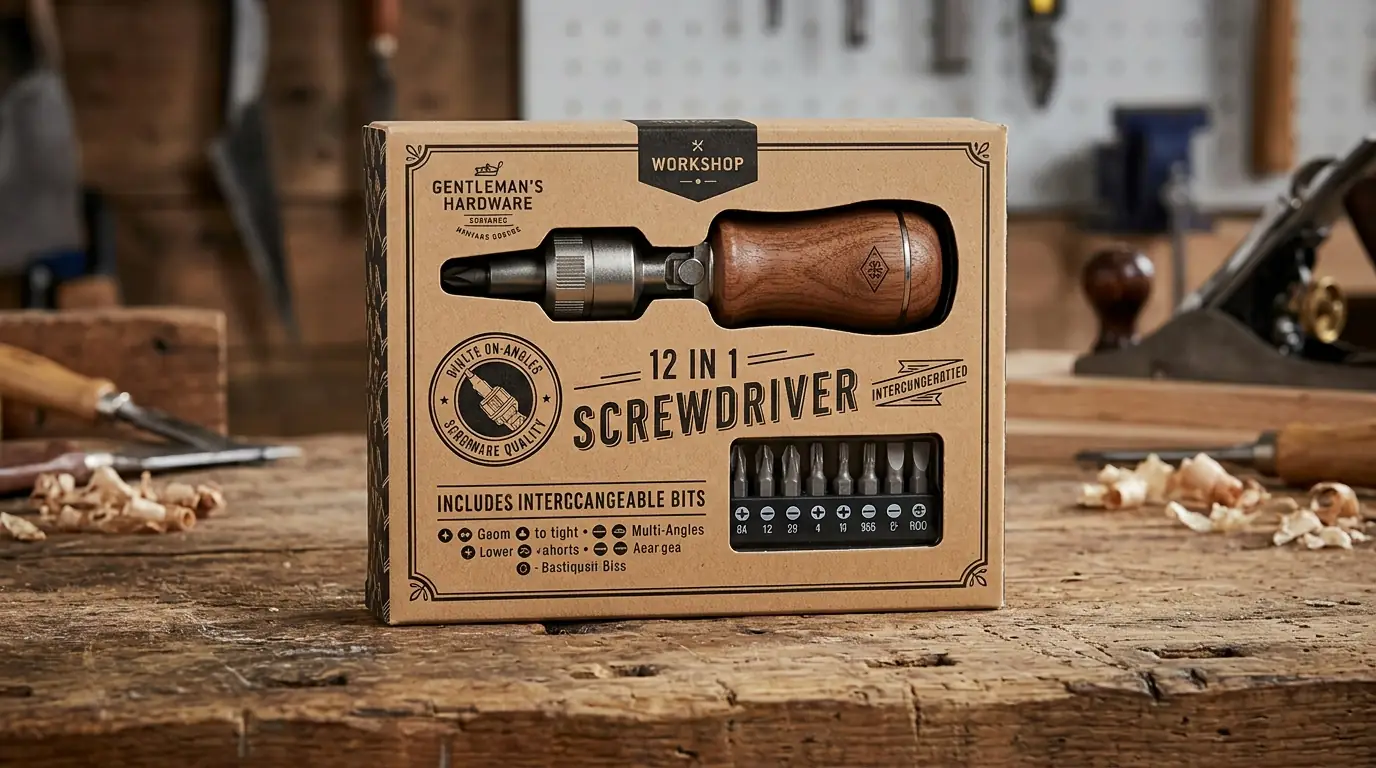
A useful hand tool needs packaging that does more than hold it on a shelf. The package must support the product, keep components together, communicate its purpose and arrive in good condition. Gentleman’s Hardware 12 in 1 screwdriver in kraft packaging brings these requirements into one compact retail format.
For packaging buyers, the interest goes beyond the brown paperboard surface. Tool weight, carton construction, internal support and printed information affect how well the package performs. A box can look suitable at first glance and still disappoint during shipping or opening.
This article examines the product’s listed features and the packaging decisions that matter. Proposed carton features are recommendations rather than confirmed specifications of the current retail box.
What Is the Gentleman’s Hardware 12 in 1 Screwdriver?
The product is listed under the Gentlemen’s Hardware brand with 12 interchangeable steel bits and a ratcheting head that swivels and locks in five positions. A US retail listing identifies it with product code GEN660 and describes its dimensions as approximately 6 inches long by 1.25 inches wide and deep.
Those features help explain the packaging challenge. The handle needs stable support, the movable head needs clearance, and the included bits must remain accounted for. Packaging should communicate the contents without suggesting that the tool suits every possible fastener.
What Does 12 in 1 Mean?
The listed description connects the number to 12 interchangeable bits. It should not be interpreted as twelve full size tools inside the carton.
Buyers should check the actual bit profiles and sizes before choosing the kit for a particular task. The package can make that easier through a readable contents panel or bit diagram. Accurate information is more useful than a broad promise that one screwdriver handles every repair.
Everyday Uses and Gift Appeal
A compact screwdriver kit can suit small household adjustments, furniture hardware and other compatible fastening tasks. Its usefulness depends on matching the bit to the screw and following the supplied instructions.
The kraft packaging box gives the product a presentation format suitable for gifting. It provides space for a product illustration, feature explanation and identification details without requiring the buyer to open the package.
What Kraft Paperboard Packaging Means
Kraft refers to a paper manufacturing process. In retail packaging, the term often describes brown paper or paperboard with a visibly fibrous surface.
Brown appearance alone does not establish the board’s composition. It cannot confirm recycled content, fiber sourcing, coating type or disposal options. Those details require supplier documentation.
Paperboard Versus Corrugated Board
Paperboard is commonly used for folding cartons, sleeves and inserts. Corrugated board contains a fluted layer between liners and is frequently used for shipping cases.
For this screwdriver, a paperboard retail carton can organize and present the product. A separate corrugated outer case may be needed for parcel delivery or bulk distribution. The required protection depends on the complete packing arrangement.
Board Thickness and Structural Performance
Board selection should account for the screwdriver’s weight, package dimensions and closure style. A heavier board can improve stiffness, but thickness alone does not determine performance.
Fiber direction, crease quality and panel layout affect how a carton folds and carries its contents. Excess material can increase cost without solving movement inside the package. Structural fit deserves attention before simply increasing board weight.
Designing the Kraft Packaging Box Around the Tool
The strongest starting point is the actual packed product. Measurements should include the handle, head, bits and any retained accessories.
A package designed only around the screwdriver’s outer dimensions may leave insufficient space for support features. It may leave too much unused room. Both problems can affect handling and presentation.
Internal Fit and Clearance
The tool should sit securely without pressing against carton walls or closures. Clearance around movable parts helps prevent rubbing and makes removal easier.
The insert keep the screwdriver from shifting inside the box. Its shape should support suitable contact points rather than squeeze the ratcheting mechanism.
A physical sample is very useful here. It reveals issues that a flat drawing cannot show, including resistance during insertion and movement after the box is closed.
Keeping the Bits Organized
Small steel bits need positive retention. A tray, fitted paperboard structure or the product’s own storage arrangement can serve this purpose, depending on the supplied kit.
Packaging engineers should verify that every component remains in place through handling. A loose bit can scratch the tool, disappear into a carton fold or fall out during opening.
The objective is simple: customers should receive the full kit and be able to identify its contents without searching through packing material.
Carton Styles and Opening Experience
Several carton structures could suit a compact screwdriver kit. The right choice depends on weight, retail display, assembly time and the desired opening experience.
Tuck End Folding Cartons
Tuck end cartons use folded flaps to close the package. They can provide a compact format and ship flat before assembly.
The closure must resist accidental opening under the tool’s weight. Flap engagement, panel stiffness and insert position all influence performance.
Some carton panels needs a wider locking area to stay closed during handling. That decision should come from prototype trials rather than appearance alone.
Reinforced Bases and Sleeve Formats
A glued or locking base may provide additional support for a heavier hand tool. It can reduce the chance of the product pushing through the bottom during lifting.
A sleeve paired with an inner tray offers another approach. It separates the printed exterior from the support structure and can make removal straightforward.
These are possible packaging formats, not a claim that the current Gentleman’s Hardware kraft packaging kit uses either construction.
Opening Without Frustration
The package should release the screwdriver without excessive pulling or unnecessary cutting. Finger access and clear opening directions can help.
A very tight insert may protect the product yet make removal awkward. Testing the opening sequence with a few users can reveal where the carton catches, bends or causes confusion.
Printing on Kraft Paperboard
Kraft surfaces affect the appearance of printed artwork. The brown background changes perceived colors, and surface texture can influence fine detail.
A screen preview does not fully represent the final result. Print samples on the intended board provide a better basis for approving artwork.
Contrast and Legibility
Dark text often offers useful contrast on brown board. Pale colors and thin lettering may become difficult to read.
The front panel should identify the screwdriver and its main purpose. Secondary panels can carry the contents, instructions, barcode and product code.
Small print details matters more than they first appear. A buyer should not need unusually close inspection to read the included features.
Product Images and Feature Diagrams
An illustration can explain the angled head or interchangeable bits without opening the box. It must represent the supplied product accurately.
Feature diagrams should distinguish tool operation from package contents. Showing a bit beside the screwdriver should not accidentally imply that additional accessories are included.
Barcode placement deserves its own check. Background variation, printing quality and folds can affect scanning.

Gift Presentation and US Retail Use
The Gentleman’s Hardware 12 in 1 screwdriver in kraft packaging box combines a practical product with a gift oriented presentation. The carton should make both aspects easy to recognize.
Gift Ready Presentation
A well fitted carton can feel orderly and complete when opened. The screwdriver should be positioned consistently, with the components visible or clearly identified.
This matters for birthdays, holiday gifts and housewarming purchases. A useful tool does not need excessive decoration, but damaged corners or loose parts can weaken the receiving experience.
Shelf and Display Planning
Retailers need packages that face consistently and remain stable in the chosen display. A standing carton, shelf tray or hanging format each creates different structural demands.
A hanging tab requires enough strength for the loaded package. Shelf displays need a stable base and readable front panel. These requirements should be established before the final carton layout is approved.
Shipping and Storage Protection
A retail gift box does not automatically provide adequate parcel protection. Shipping introduces drops, vibration, stacking pressure and repeated handling.
Controlling Movement During Delivery
The outer shipping case should limit movement of the retail carton. Internal packing should prevent the metal tool from striking or puncturing paperboard panels.
These checks helps identify weak points before a larger production run. Inspect the tool, insert, corners and closures after trials, rather than looking only at the outer case.
Moisture and Surface Damage
Paperboard can lose stiffness after moisture exposure. Humid storage, wet handling and unsuitable transport conditions can affect the carton.
Scuffing presents a separate concern. Printed kraft surfaces may rub against neighboring cartons or packing materials. Any protective finish should be evaluated for appearance, performance and its effect on material recovery.
Sustainability and US Packaging Research
Kraft packaging has a recognizable paper based appearance. Environmental performance requires a closer look at the full package.
The amount of board, recycled content, coatings, inserts and disposal route all contribute. A brown carton is not automatically plastic free, recyclable everywhere or environmentally preferable.
What US Recycling Data Shows
EPA data estimated that 68.2 percent of paper and paperboard in US municipal solid waste was recycled in 2018. The same dataset reported different rates for different categories, including 20.8 percent for paper containers and packaging excluding corrugated boxes. These historical figures do not establish the recycling rate of this particular carton.
The practical lesson is to evaluate folding cartons separately from corrugated shipping boxes. Local collection rules and package construction still matter.
Environmental Claims Need Evidence
FTC guidance discourages broad, unqualified environmental benefit claims. Its Green Guides recommend qualifying recyclable claims if appropriate facilities are unavailable to at least 60 percent of consumers or communities where the product is sold.
Packaging copy should identify the relevant component and the supported benefit. A statement about recycled content needs documentation. A claim about the carton should not imply that the steel tool shares the same attribute.
Packaging Cost and Quality Checks
An affordable carton is one that performs at an appropriate total cost. The lowest unit price can become expensive if assembly takes longer or products arrive damaged.
What Affects Packaging Cost?
Common cost factors include:
- Paperboard grade and material quantity.
- Carton dimensions and cutting layout.
- Printing colors and surface finishes.
- Insert complexity and assembly time.
- Order volume and tooling requirements.
- Shipping case size and packing materials.
Comparisons should use equivalent specifications. A quoted price means little without knowing what structure, board and printing it covers.
Before Approving Production
Review a physical packaging sample with the actual screwdriver kit. Check fit, component count, closures, opening effort and printed information.
Confirm that artwork matches the supplied model. Product specifications, contents and disposal statements should be checked independently rather than copied from an unrelated carton.
Frequently Asked Questions
Is the Kraft Box Suitable for Gifting?
It can provide a useful gift presentation. The condition of the carton, internal organization and accuracy of the contents affect the experience.
Does the Package Contain Twelve Separate Screwdrivers?
The product listing describes 12 interchangeable steel bits used with one screwdriver. Check the supplied contents for the exact profiles and sizes.
Is Kraft Paperboard Waterproof?
Ordinary kraft paperboard is not waterproof. Any moisture resistance depends on its treatment and complete construction.
Can the Box Be Recycled in the United States?
Acceptance depends on the local program and the carton’s materials. Separate removable components and follow the printed disposal instructions.
What Should Buyers Check Before Ordering?
Confirm the model, included bits, package condition and relevant instructions. For packaging procurement, request board specifications, a physical sample and evidence supporting any environmental claims.
A successful kraft package supports the tool, keeps its components together and presents clear information. That combination gives the screwdriver a practical retail box that works from packing through delivery and opening.