Measuring a box sounds like a very simple job. You put a ruler or measuring tape against the carton, write down three numbers, and you are finished. In packaging work, those three numbers can affect carton fit, shipping charges, storage space, product protection and how a paperboard package is produced.
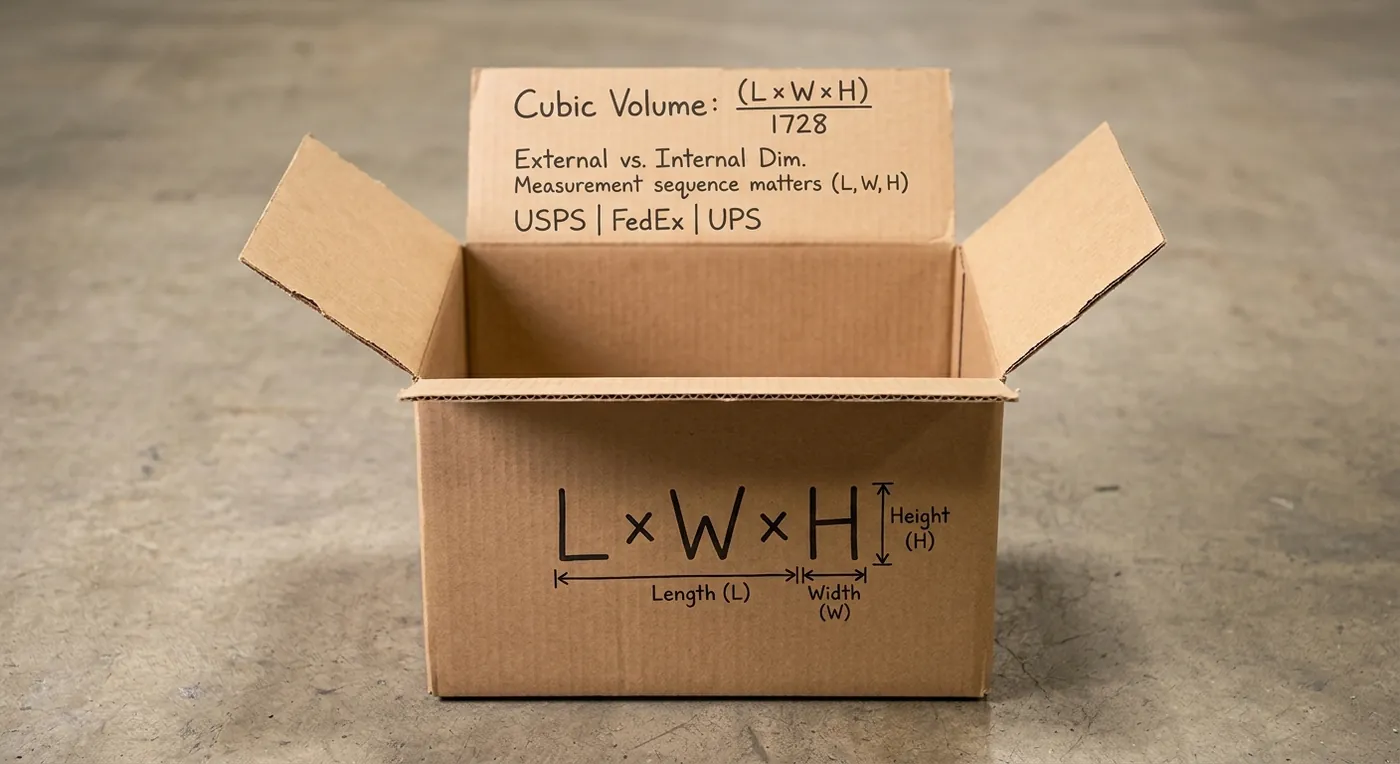
Box dimensions are commonly written as Length × Width × Height, often shortened to L × W × H. Keeping this sequence correct matters when ordering paperboard boxes or entering package information for USPS, UPS, FedEx, eBay, or another shipping service. The supplied keyword research places strong focus on box dimensions, Length, Width, Height and carrier related measurement searches. Pasted text
This guide explains how to measure a box, how internal and external measurements differ, how to calculate volume, cubic feet, cubic inches, CBM and girth, plus common measurement mistakes.
What Are Box Dimensions?
Box dimensions describe the physical size of a carton using three measurements. They are Length, Width and Height.
For most rectangular paperboard boxes, the dimensions are written in this sequence:
Length × Width × Height
Suppose a carton measures 12 inches on its longest horizontal side, 8 inches on its shorter horizontal side, and 4 inches from bottom to top. Its dimensions would be written:
12 × 8 × 4 inches
The sequence matters. A packaging supplier reading 12 × 8 × 4 expects the first number to represent Length, the second Width and the third Height.
Some people use the word depth instead of Height. In many packaging situations, depth describes the distance from the opening of a carton down to its base. That measurement usually corresponds with Height.
Search terms in the supplied research show people frequently look for methods covering box Length, Width, Height, depth, inside dimensions and shipping dimensions. Pasted text
How to Measure a Box Length Width and Height
Get a measuring tape or ruler and place the box on a flat surface. If it is a folding paperboard carton, assemble it into its normal finished shape before measuring.
Step 1: Measure the Length
Look at the opening or top face of the box.
The Length is normally the longest side of that face. Place the measuring tape from one end to the other and record the number.
For example, if the longest side measures 14 inches, your Length is 14 inches.
Step 2: Measure the Width
The Width is the shorter side of the same face.
Measure from one edge to the opposite edge. If it reads 9 inches, the Width is 9 inches.
You now have:
14 × 9
Do not switch the two measurements just since the carton happens to be turned in another direction on your table.
Step 3: Measure the Height
The Height runs vertically from the base to the top.
Measure the box from bottom to top. If this measurement is 5 inches, the finished box size is:
14 × 9 × 5 inches
It really is that simple for a standard rectangular carton, yet mistakes happen very often when people change the order or mix internal measurements with outside measurements.
Inside Dimensions vs Outside Dimensions
This is one of the bigger points in paperboard packaging.
Inside dimensions describe usable space inside the carton. Packaging manufacturers often need internal dimensions when a package must fit a particular product.
Outside dimensions describe the complete external size of the assembled box. Shipping carriers care about external measurements since the physical package takes that amount of space during handling and transportation.
These numbers are not always identical. Paperboard has thickness. Folding structures, overlapping panels and other construction details can add a small amount to the external measurement.
For a product measuring 10 × 6 × 3 inches, ordering a box with exactly the same external dimensions could leave less usable room inside than expected. This is where one can get a box that looked right on paper but does not fit right in hand.
When talking with your packaging supplier, state whether your measurements are inside dimensions or outside dimensions. It saves a lot of back and forth later.
How to Measure a Paperboard Packaging Box
Paperboard cartons need a little more care since their construction can affect the final dimensions.
Start by fully assembling the carton. Close the bottom and form the top as it would appear during actual use. Do not measure a flat carton blank and treat those numbers as the finished box size.
Measure the longest side of the opening for Length. Measure the shorter side for Width. Measure from the bottom panel to the top for Height.
For product packaging, internal dimensions may be more useful. Insert a ruler inside the assembled carton and measure the usable space between the inner walls.
If the product has inserts, trays, folded panels or partitions, account for the space these parts consume. A carton may technically measure 8 inches wide yet offer less actual product space after an insert goes inside.
This small detail get missed more than people expect.
How to Measure a Box for Shipping
Shipping measurements should represent the outside of the finished parcel.
Pack the product, close the carton and apply normal packing material before taking final dimensions. Measure the longest point for Length, the next dimension for Width, and the vertical dimension for Height.
A bulging side can change the actual parcel size. A box listed as 12 inches wide may become 12.5 inches after being overfilled.
Carrier pricing can depend on package dimensions and dimensional weight, so using an old specification instead of measuring the packed parcel may give a wrong shipping estimate.
The supplied semantic terms repeatedly connect box measurement with shipping, mailing, courier services and rectangular shipping boxes. Pasted text
How to Measure a Box for USPS
For USPS shipping, measure the exterior dimensions of the prepared parcel.
USPS shipping situations may require Length, Width and Height. Certain size rules can involve Length plus girth, so knowing how to calculate girth is useful.
The keyword set provided for this article includes USPS shipping, USPS Ground Advantage and girth related searches. Pasted text
Carrier requirements and pricing rules can change, so check current USPS requirements before purchasing postage for a parcel close to a size limit.
How to Measure Box Girth
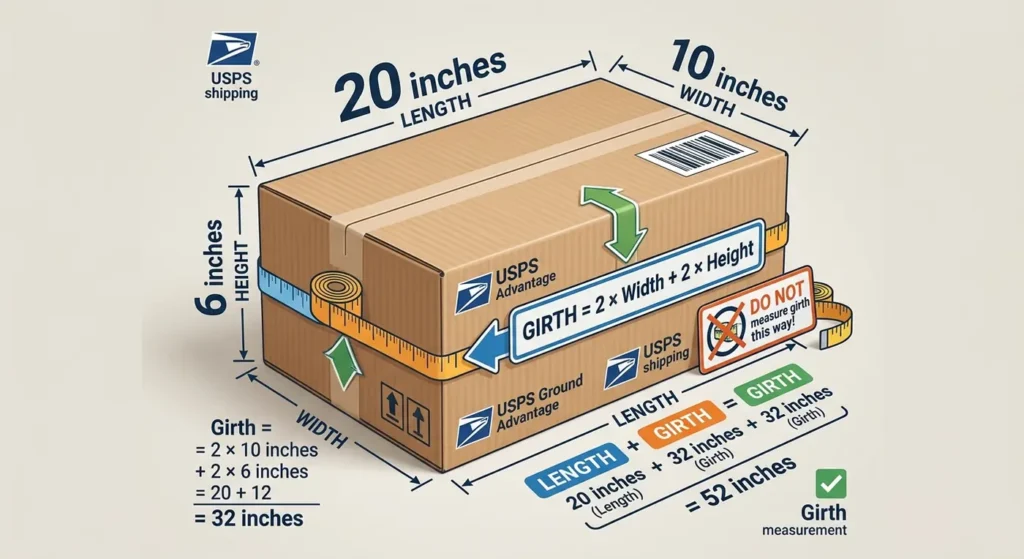
For a rectangular box, girth is the distance around the two smaller dimensions.
- A common calculation is:: Girth = 2 × Width + 2 × Height
- For a box measuring:: 20 × 10 × 6 inches
- The girth is:: 2 × 10 + 2 × 6 = 32 inches
- Length plus girth would then be: 20 + 32 = 52 inches
Do not measure girth by wrapping the tape around the longest dimension. Length is handled separately in this calculation.
How to Measure a Box for UPS
For UPS, use the external dimensions of the closed shipping package. Measure the longest side as Length, then record Width and Height.
If the box has an unusual shape or parts extend beyond the normal carton walls, measure the maximum dimensions occupied by the parcel rather than the neat dimensions printed on a carton specification.
UPS may use dimensional measurements when determining shipping charges. For that reason, squeezing the measurement down or rounding carelessly could cause a difference between your estimate and the carrier’s measured package.
The research supplied for this article includes multiple variations of searches for UPS box measurement and shipping. Pasted text
How to Measure a Box for FedEx, eBay and Other Shipping
The physical measuring method remains basically the same.
Measure the packed parcel from its outermost points and record:
- Length, the longest side
- Width, the shorter side
- Height, the remaining dimension
FedEx shipping information may ask for dimensions to determine shipment size and applicable pricing.
For eBay, marketplace sellers enter package dimensions when preparing shipping information. The numbers should describe the parcel that will actually be handed to the carrier, not just an empty box pulled from storage.
The same principle works for mailing boxes, moving boxes, courier boxes and many ecommerce shipments.
How to Calculate the Volume of a Box
Once you have Length, Width and Height, calculating box volume is straightforward.
Use:
Volume = Length × Width × Height
- Suppose a box measures: 16 × 10 × 5 inches
- Its volume is: 16 × 10 × 5 = 800 cubic inches
Volume can help packaging teams compare carton capacities, estimate storage requirements, review product fit and choose between different packaging sizes.
How to Calculate Cubic Feet
If the dimensions are measured in inches, calculate cubic inches first.
Then divide the result by 1,728, since one cubic foot contains 1,728 cubic inches.
For example: 24 × 18 × 12 = 5,184 cubic inches
Then: 5,184 ÷ 1,728 = 3 cubic feet
This gives a box volume of 3 cubic feet.
How to Calculate Box CBM
CBM means cubic meters and is frequently used in freight and logistics.
If your box measurements are in meters:
CBM = Length × Width × Height
For a carton measuring: 0.50 × 0.40 × 0.30 meters
The calculation is: 0.50 × 0.40 × 0.30 = 0.06 CBM
If you measure in centimeters, you can multiply the three dimensions and divide the result by 1,000,000.
The supplied keyword research includes searches for box CBM, cubic feet, cubic inches and box volume. Pasted text
Measuring a Box in Inches or Centimeters
You can measure boxes in inches or centimeters. What matters is keeping the unit consistent.
If Length is recorded in inches, do not record Width in centimeters inside the same dimension set.
Write the unit next to the measurement:
12 × 8 × 4 inches
or
30 × 20 × 10 cm
This looks basic, but a missing unit can create real problem in packaging orders, especially where suppliers and customers use different measurement systems.
How to Measure a Square Box
A square box still uses three dimensions.
If the top has equal sides and the carton is 10 inches tall, its measurements might be:
8 × 8 × 10 inches
Length and Width happen to be equal, but both should still be stated.
For a cube measuring 8 inches on every side, write:
8 × 8 × 8 inches
How to Measure a Long or Large Box
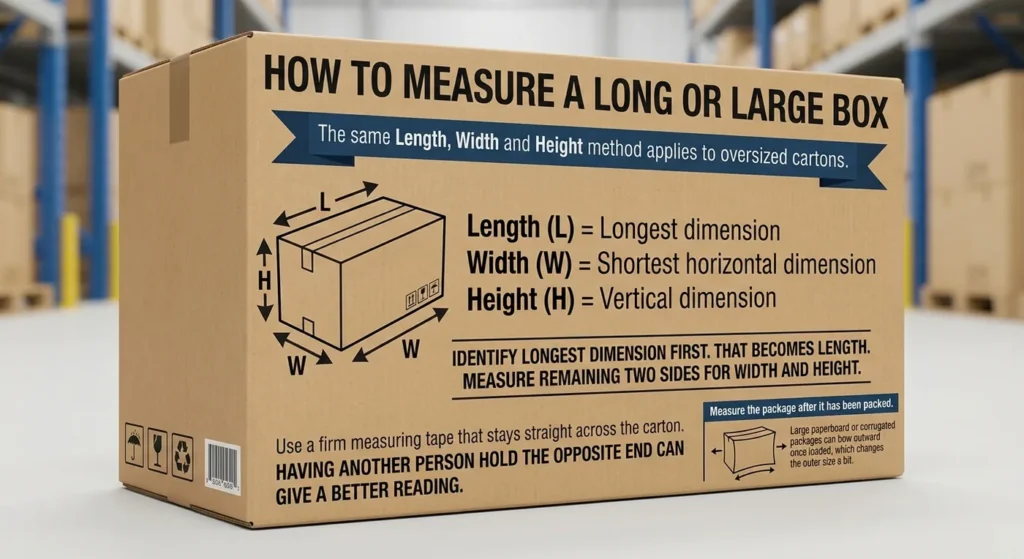
The same Length, Width and Height method applies to oversized cartons.
With a long carton, identify the longest dimension first. That becomes Length. Measure the remaining two sides for Width and Height.
Use a firm measuring tape that stays straight across the carton. On a very large box, having another person hold the opposite end can give a better reading.
Measure the package after it has been packed if shipping dimensions are needed. Large paperboard or corrugated packages can bow outward once loaded, which changes the outer size a bit.
Common Box Measurement Mistakes
Several mistakes appear again and again in packaging work.
- Measuring Width before Length and reporting the numbers in the wrong sequence
- Using internal dimensions for a carrier shipment
- Using external dimensions when ordering a product fit carton
- Measuring a flat carton rather than the assembled box
- Forgetting paperboard thickness
- Mixing centimeters and inches
- Measuring an empty box instead of the packed shipping parcel
- Ignoring bulges, inserts or protruding sections
- Rounding every measurement down
- Forgetting to label the measurement unit
One measurement error might look very small. Across hundreds or thousands of packages, it can create fitting issue, extra material use, incorrect freight estimates and wasted storage space.
Getting Box Measurements Right
Knowing how to measure a box correctly is a small skill with a very practical effect on paperboard packaging. Start with Length, move to Width and finish with Height. Use internal dimensions when the product needs to fit inside a carton and external dimensions when the finished package itself is being measured.
For shipping, measure the packed box rather than relying only on an old carton specification. For packaging production, communicate measurement order and units clearly. It keeps product fit, material use, shipping calculations and carton specifications more consistent, and that makes the whole packaging process work a little better.
Frequently Asked Questions About Measuring a Box
What order are box dimensions written in?
Box dimensions are commonly written as Length × Width × Height. Length normally represents the longest side of the box opening.
How do you measure a cardboard box correctly?
Assemble the box, place it on a level surface and measure Length, Width and Height. Use internal measurements for product fit and external measurements for shipping size.
Is depth the same as Height?
In many box specifications, depth refers to the third dimension and can correspond with Height. Terminology can vary by carton style, so clarify the dimension order with your packaging supplier.
Do I measure the inside or outside of a box?
That depends on the purpose. Measure the inside when evaluating product fit or specifying usable packaging space. Measure the outside when calculating shipping dimensions or physical storage requirements.
Can I measure a box with my phone?
A phone measurement app can provide an approximate size. A ruler or measuring tape is a better option where exact packaging dimensions matter. For production packaging, actual physical measurements should be checked.
How do I measure a box without a ruler?
You can estimate dimensions using an object with a known size, yet the result may be inaccurate. For packaging production or shipping, use a real measuring tool before submitting final measurements.
How do I give box measurements to a packaging company?
State the numbers in Length × Width × Height order, include the unit and tell the supplier whether they are internal or external dimensions. For example: 12 × 8 × 4 inches, internal dimensions.