
Paperboard tube packaging gives supplement products a cylindrical container with room for product information, printed graphics and organized presentation. For capsules, powder sachets, gummies, or nutrition kits, the tube usually serves as an outer package around a sealed bottle or bag. Its value comes from matching the structure to the actual product rather than choosing a shape for appearance alone.
US businesses searching for tube packaging supplement options need answers about materials, labels, moisture protection, manufacturing, and delivery. A paper tube can support an attractive product launch, but its usefulness depends on the inner container, the closure and the distribution route. That is where packaging decisions really start.
What Is Paperboard Tube Packaging for Supplements?
The Difference Between an Outer Tube and a Primary Container
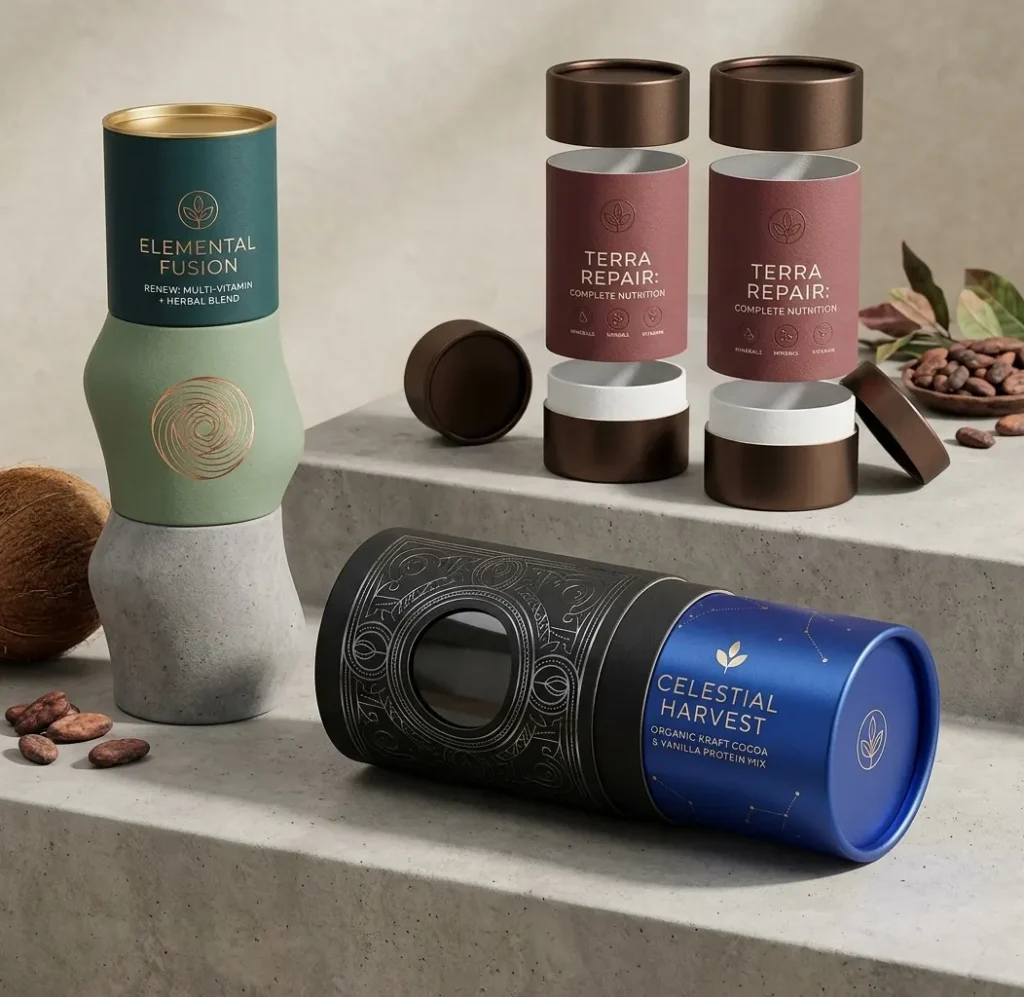
A paperboard tube is formed from layers of paper wound into a cylinder. It may have a removable lid, a fixed bottom, an internal shoulder, or separate sections that slide together. Printed paper wraps provide the visible surface.
Primary packaging touches or directly contains the supplement. Secondary packaging surrounds that primary container. A paper tube holding a sealed capsule bottle is secondary packaging. A tube filled directly with powder becomes part of the primary packaging system and needs suitable contact materials, barriers, seals, and product compatibility testing.
Paperboard Tubes Versus Bottles, Jars, and Bags
High density polyethylene, or HDPE, bottles and sealed flexible bags can perform the direct containment role. A paperboard tube can surround them for presentation and physical support. Glass jars may need inserts that reduce movement and prevent contact with the tube wall.
The tube give a bottle another layer of presentation. It adds material and cost, too. Compare the complete package with a folding carton, a pouch, and a bottle alone before approving it.
Supplement Applications and Product Compatibility
Capsules, Gummies, Powders, and Dissolvable Products
Tube packaging supplement application planning starts with the product form. Capsules and tablets can remain in sealed bottles or blister packs inside the cylinder. Gummies need packaging suited to their moisture content and potential sticking. Powders often use sealed pouches, sachets or stick packs held inside a paperboard shell.
Dissolvable tablets can be highly sensitive to moisture. Their primary container may require a suitable moisture barrier and a validated desiccant system. A decorative paper lid cannot replace these functions. Supplement oils need compatible sealed bottles; unlined paperboard is a poor choice for direct liquid containment.
Packaging for Women, Joint Support, and Nutrition Kits
The same tube structure may support products positioned for women, sports nutrition, joint support, or keto routines. Ingredient properties and pack size determine protection needs more reliably than the marketing category. A kit with several items needs dividers, an inventory count, and instructions that keep different serving directions distinct.
Products for dogs follow a separate regulatory path. FDA states that the Dietary Supplement Health and Education Act does not apply to animal food. Human supplement labeling templates should not be copied onto pet products without a separate review. FDA
Tube Packaging Supplement Benefits and Limitations
Presentation, Organization, and Everyday Use
A cylindrical package offers a continuous printed surface and a recognizable shape. The lid can make access straightforward, and an insert can hold the inner container in place. A good fit feels very reassuring during opening, especially with a glass bottle or a kit containing several components.
Practical benefits include:
- Space for product identity, directions, and supporting information.
- Organized storage for sachets or multiple supplement items.
- Physical support for an inner bottle when the structure is tested.
- A reusable outer container for customers who choose to retain it.
These benefits are very useful, but the cylinder has tradeoffs. Round units can roll, waste space in rectangular shipping cases, and occupy more storage volume than flat cartons. An attractive package still has to make financial sense.
Consumer Experience and US Research
The National Center for Health Statistics reported that 57.6 percent of US adults aged 20 and older used a dietary supplement during the previous 30 days in its 2017 to 2018 survey. The report was published in 2021. These are historical supplement use figures, not evidence that shoppers prefer paper tubes. February 2021
My packaging interpretation is that a widely used product category deserves accessible directions and readable labels. One should test lid removal, label visibility, and bottle extraction with actual users. You can learn more from a short handling test than from broad claims about the most popular packaging.
Materials, Barriers, and Tube Construction
Paperboard Grade and Structural Choices
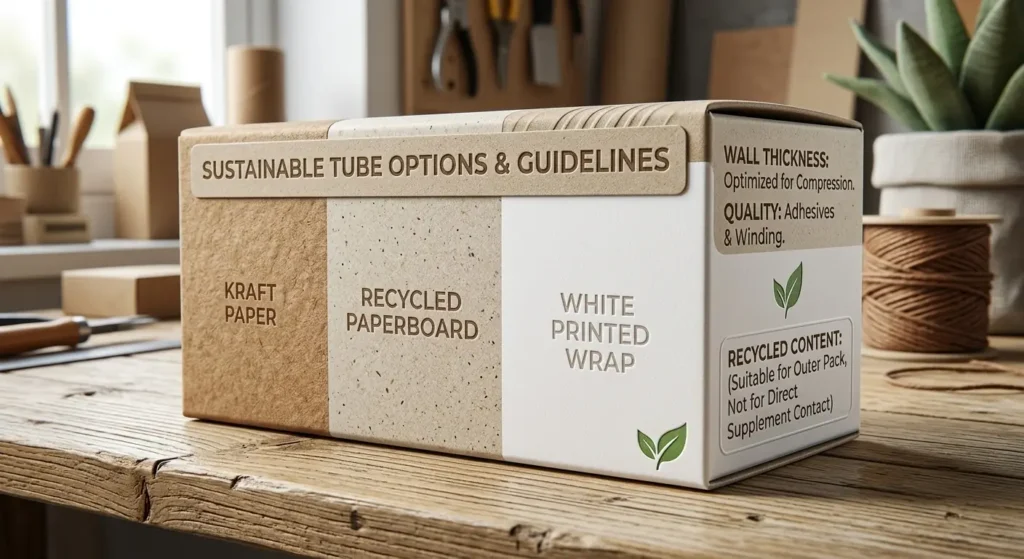
Kraft paper, recycled paperboard, and white printed wraps offer different appearances and construction options. Wall thickness, paper quality, adhesive performance, and winding method affect how the tube handles compression. Recycled content can be suitable for an outer pack without automatically being suitable for direct supplement contact.
Tube construction deserves a close look:
- Internal diameter must accommodate the bottle, pouch, or insert.
- Usable internal height must allow lid engagement and product removal.
- The base needs enough support for the filled product weight.
- The lid fit should remain usable after storage and handling.
- Seams and exposed edges need inspection for separation or damage.
Moisture, Oxygen, Light, and Product Contact
Paperboard absorbs moisture and does not provide an airtight barrier by itself. Humid storage can affect stiffness and lid fit. A printed wrap may reduce light exposure, but oxygen protection depends on the primary container and its seal.
For direct contact applications, request documentation for the liner, adhesives, coatings and any other relevant materials. Evaluate migration, odor transfer, leakage, and barrier performance for the intended formula. The words ‘food grade’ should lead to documented suitability, not a quick assumption.
Tube Packaging Supplement Design and Inserts
Artwork on a Curved Surface
Design a clear front viewing area for product identity and net quantity. Place secondary information where a customer can rotate the tube comfortably. Keep small text away from the wrap seam and avoid artwork that depends on perfect alignment between lid and body.
Barcode placement needs physical testing on the finished cylinder. Curvature, glare, print contrast, and surface texture can affect scanning. A digital proof cannot show every problem that appears after the wrap is applied.
The packaging designer reviews appearance; the Packaging Designer may then check usability. Both tasks matter. This is actually the point where a nice drawing becomes a working package.
Inserts and Opening Experience
Paperboard rings, folded dividers, and molded fiber inserts can hold a bottle or separate kit components. A insert should support the product without making removal frustrating. Avoid excessive friction around glass, and check whether the customer can reach smaller items near the bottom.
Request two sample before the production order. Use one for product fitting and retain another as the agreed reference for construction, color and lid fit.
US Labeling Requirements and FDA Rules
Required Information on Supplement Packaging
FDA identifies core supplement label information that includes a statement of identity, net quantity of contents, Supplement Facts, other ingredients, and the name and place of business of the manufacturer, packer, or distributor. Some eligible products have nutrition labeling exemptions. A domestic address or phone number for serious adverse event reporting is another requirement. FDA
A tube does not remove these obligations. Review which information must appear on the outer package and the immediate container for the actual configuration. Do not assume an enclosed bottle label makes an opaque outer tube acceptable.
The final label need a readable layout. Serving size, servings per container, ingredient amounts, directions, warnings, and storage guidance should work together. Distinguish a serving from an individual capsule so consumers are not left guessing about dosage.
Health Claims and FDA Language
FDA does not approve dietary supplements or their labels before sale. Avoid printing unsupported FDA approval language on the tube. Structure and function claims require substantiation, the required disclaimer, and notification to FDA within 30 days after first marketing with the claim. Disease claims can change the product’s regulatory status. FDA
Expiration Dates, Manufacturing, and Quality Control
Shelf Life and Traceability
FDA’s supplement manufacturing guidance states that the dietary supplement CGMP rule does not require an expiration date. Any expiration or similar date placed on the label should have supporting data. A paperboard tube cannot establish shelf life on its own. FDA
Reserve an accessible area for batch identification and any supported expiration date. Check that coding remains legible after rubbing, transit, and storage. Record the packaging version used for each production run so artwork changes can be traced.
Equipment and Packaging QC
Manufacturing can involve paper winding, adhesive application, cutting, wrapping, base attachment, and lid assembly. Filling and sealing operations depend on whether the supplement is contained in a bottle, bag or lined tube. Equipment compatibility should be discussed before dimensions are finalized.
Dietary supplement packaging and labeling operations fall within 21 CFR Part 111 where applicable. Its controls address packaging specifications, quality control, records, and packaging operations. ecfr.gov
A practical inspection plan should check dimensions, closure fit, print accuracy, insert retention, surface odor, and visible damage. Agree on acceptance criteria before production. It is just easier to resolve a defect when both parties know what counts as one.
Delivery, Sustainability, and Purchasing in the USA
Shipping Cases and Distribution Testing
A retail tube usually needs a suitable shipping case or mailer. Assess drops, vibration, stacking pressure, and humidity using a test plan matched to the distribution route. Review the tube, inner pack, inserts and shipping case together.
For direct delivery, compare the packed dimensions and weight against carrier charges. A larger cylinder may increase shipping cost through dimensional weight. Ask the fulfillment center whether its equipment and storage layout can handle the shape efficiently.
Recycling and Environmental Claims
Paper content alone does not make the complete package recyclable everywhere. Liners, plastic caps, foil layers, and coatings can affect local acceptance. Give disposal guidance that reflects the actual construction.
FTC guidance says recyclable claims should be qualified if suitable recycling facilities are unavailable to at least 60 percent of consumers or communities where the product is sold. Broad environmental claims need evidence. Recycled content and recyclability describe different attributes. Federal Trade Commission
Comparing Manufacturers and Order Costs
When contacting tube packaging supplement manufacturers in the USA, request an itemized quote covering materials, printing, inserts, setup, quantity, freight, and lead time. Ask where production occurs and what part of the work the supplier performs.
Use this purchasing sequence:
- Define the supplement form and validated primary package.
- Provide product dimensions, weight, artwork, and order quantity.
- Approve a physical sample and written specifications.
- Review labeling and distribution performance.
- Confirm production timing, inspection records and reorder terms.
An affordable tube is one that meets the agreed requirements at a workable total cost. Ask when you will recieve samples and how production changes are communicated. The lowest unit quote can become expensive if inserts, assembly or damaged deliveries were omitted.
Questions and Answers
Can supplements go directly inside paperboard tubes?
They can in a validated packaging system with suitable contact materials, barriers, and seals. A plain decorative tube is not a substitute for that system.
Are paperboard supplement tubes waterproof?
Ordinary paperboard tubes are not waterproof. Coatings may improve resistance, but protection must be verified for the intended storage and delivery conditions.
Can a tube replace supplement bottles?
A tube can replace a bottle only if the proposed primary packaging system meets the product’s containment and protection needs. Many applications retain a sealed bottle or pouch inside.
What makes the best tube packaging supplement design?
The best design for a particular product combines appropriate protection, readable US labeling, easy opening, manageable shipping costs, and documented production quality. Start with the supplement and build the tube around those requirements.