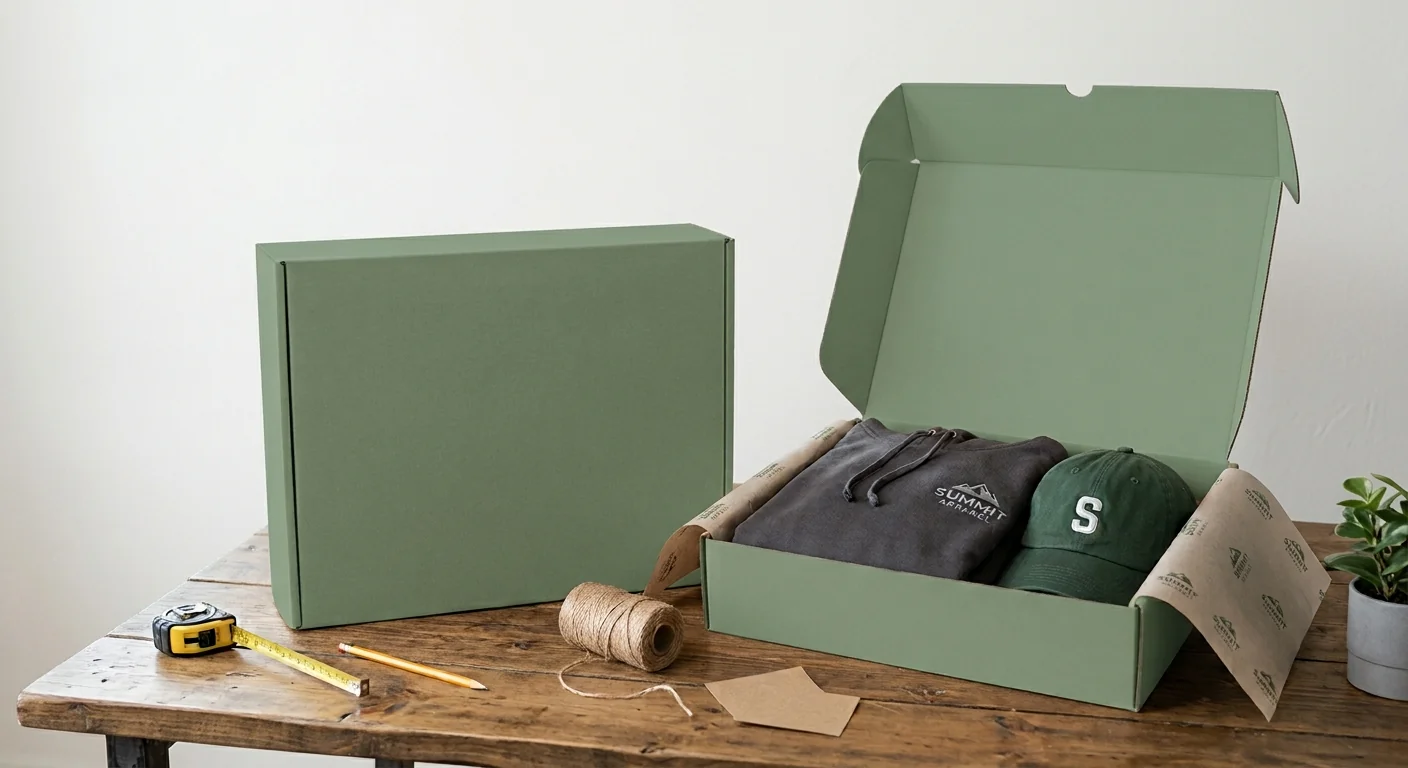
Hoodie and hat packaging has two different jobs inside one package. A hoodie needs room for its fabric, seams, hood, and decoration. A hat needs support that protects its crown and brim. Putting both items into a large box without planning can leave the sweatshirt wrinkled and the cap flattened.
Good paperboard packaging starts with the actual products. Their folded measurements, fabric weight, hat construction and sales channel determine the structure. From simple retail cartons to premium gift sets, the right package gives apparel businesses a practical way to protect merchandise and present a coordinated outfit.
1. What Makes Hoodie and Hat Packaging Different?
Soft garments and shaped headwear
A fleece hoodie can usually tolerate gentle folding. A structured baseball cap cannot always tolerate the same pressure. Its front panels, embroidered logo, and curved visor may lose their intended shape under a heavy garment.
Beanies and soft bucket hats offer more flexibility. These products can fit beside a folded hoodie or within a shallow compartment. The folded garment need enough space to sit without forcing the lid upward.
Packaging for individual items and matching sets
A matching beanie set may work in one folding carton with tissue between the products. A hoodie and baseball cap combo often needs a deeper box with separate sections.
For retail displays, focus on appearance, access and readable product information. For online orders, assess handling damage, closure security, and shipping cost. A presentation box that works on a store shelf may need another protective layer for delivery.
2. Paperboard Materials and Box Styles
Folding carton paperboard
Solid bleached sulfate, commonly called SBS, offers a white printing surface suited to detailed graphics. Coated recycled board provides another option, subject to the supplier’s material specifications. Kraft paperboard gives a brown appearance that suits simple apparel packaging.
Board thickness alone does not determine performance. Grain direction, carton dimensions, folds and closure style affect stiffness. Ask for board caliper and material details rather than accepting a vague description such as “thick cardboard.”
Folding boxes, sleeves, and rigid boxes
Tuck end cartons work for lighter products and compact sets. Glued bottom cartons can reduce assembly time, provided the structure supports the packed weight.
Paperboard sleeves hold a folded hoodie or surround an existing carton. They use less material than a full enclosure but leave parts of the product exposed.
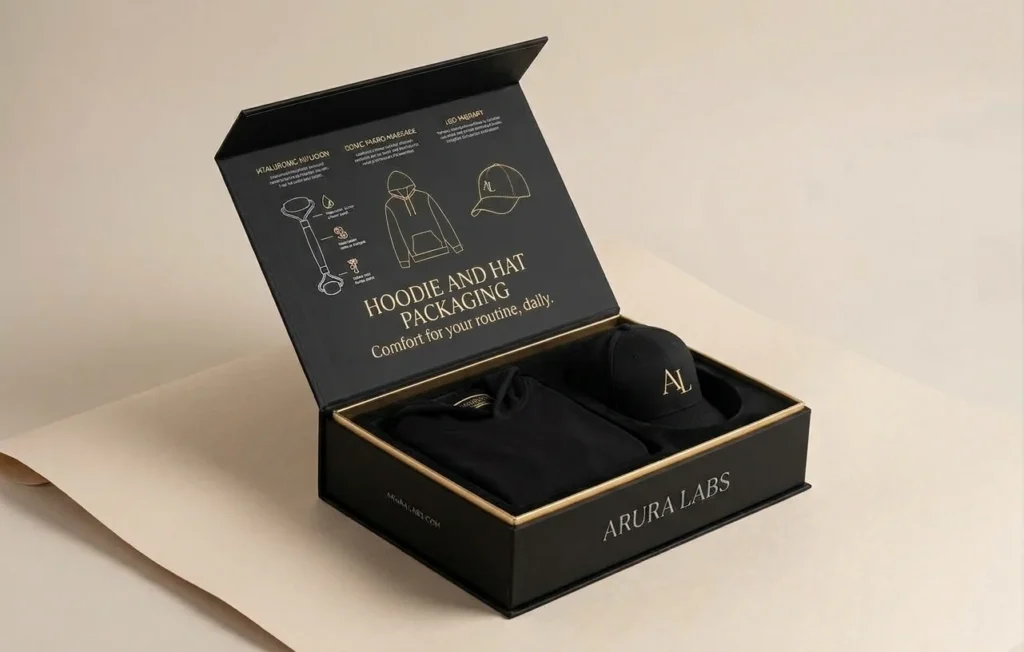
Rigid setup boxes use heavier paperboard wrapped with printed paper. A separate lid or drawer structure suits luxury hoodie packaging and gift presentations. These boxes usually require more storage space than cartons supplied flat.
Retail packaging versus shipping protection
Paperboard folding cartons differ from corrugated shipping boxes. Corrugated board contains a fluted layer that provides cushioning and structural support.
For shipping, place the paperboard presentation package inside a suitable outer container when testing shows that extra protection is needed. Do not assume a decorative folding carton can survive parcel handling on its own.
3. Hoodie and Hat Packaging Dimensions
Measure the products before choosing a box
There is no universal hoodie and hat packaging box size. An XS lightweight hoodie occupies much less space than an XXL fleece garment. A flat beanie needs less height than a structured cap.
Measure the hoodie after folding it exactly as the packing team will fold it. Measure the hat in its supported position. Record length, width, height, and the combined packed weight.
The measurements should include tissue, inserts and any printed cards. Check the largest garment size planned for that carton.
Example starting dimensions
These internal dimensions are prototype starting points, not standard sizes:
- A lightweight folded hoodie might start with a box measuring 12 by 10 by 3 inches.
- A hoodie with a flat beanie might need approximately 14 by 11 by 4 inches.
- A hoodie with a structured baseball cap might start around 16 by 12 by 6 inches.
Actual products may need smaller or larger cartons. Side by side arrangements require more width. Stacked arrangements require more height and protection between the items.
Internal dimensions describe usable space. External dimensions determine the parcel footprint. Confirm which measurement the supplier uses before placing an order.
4. Hoodie and Hat Packaging Ideas That Work
Separate compartments for coordinated sets
A folded paperboard partition can keep the hoodie away from the cap. Position the garment in one section and support the hat in another.
Two paperboard divider can prevent the hoodie from sliding into the brim area. The insert should hold products without pulling on embroidery, buttons or adjustment straps.
For beanies, a shallow tray or paper band may provide enough separation. More structure is not automatically better. An insert should solve a real movement or presentation problem.
Gift packaging with useful details
A printed lid interior, thank you card, and matching tissue can make a set feel complete. Use a small paper pocket for a gift message or receipt.
Seasonal hoodie and hat packaging design can rely on a replaceable sleeve rather than an entirely new box. This makes smaller campaign quantities more practical.
A useful hoodie and hat packaging hack is to use one tested base carton with different inserts for beanies and caps. Test both arrangements before committing to the shared size.
Boxes and bags serve different purposes
A paper bag can carry an apparel purchase from a store. It offers limited support for a structured hat and should not be treated as equivalent to a protective box.
For businesses evaluating a hoodie and hat packaging bag, consider the customer’s trip home, the garment weight and the cap shape. Paperboard boxes provide firmer walls and more opportunities for fitted compartments.
5. Packaging Design, Templates, and Printing
Start with a structural template
A hoodie and hat packaging template should show cut lines, fold lines, glue areas, bleed and safe artwork zones. This production drawing is often called a dieline.
Use the supplier’s approved dieline for the selected structure. A generic free template may have different closures or unsuitable dimensions.
A sample box give you a better view of fit than a digital mockup. Assemble it, load the actual products, and check the lid, corners and insert.
Prepare artwork for production
Digital printing can suit smaller quantities and multiple artwork versions. Offset printing may offer better unit economics at larger volumes. Ask the supplier to quote the same specifications for a fair comparison.
Supply logos as vector artwork where possible. Use the printer’s requested color settings, image resolution, and file format. Review small text at its actual printed size.
The final proof include the barcode, product name and artwork placement. Approval should cover the structure and printing, not just the logo.
Finishes and product contact
Embossing, foil stamping, spot varnish and matte finishes create different visual effects. Compare their cost and recycling implications before selecting them.
Check that inks, coatings and adhesives have fully dried or cured before packing garments. Test for odor, surface rubbing and color transfer. A very attractive printed interior is still a problem if it marks a pale hoodie.
6. How to Package Hoodie and Hat Orders
Build a repeatable packing routine
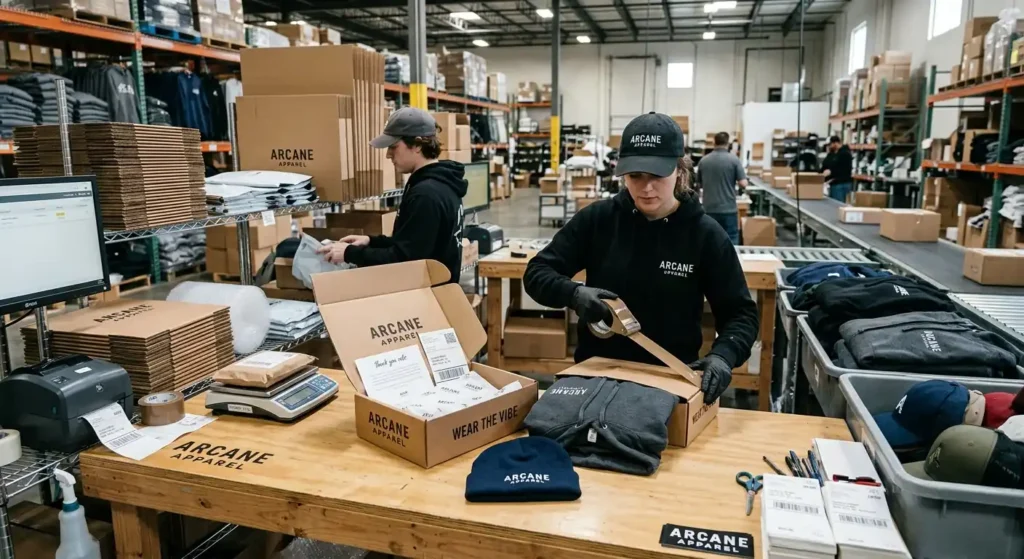
Packaging hoodie orders consistently reduces guesswork at the packing table. Keep approved folding instructions and a completed sample nearby.
Use this sequence:
- Confirm the garment size, hat style, color and order contents.
- Fold the hoodie without pressing directly across sensitive decoration.
- Wrap the garment with suitable tissue if needed.
- Place the hat into its support or compartment.
- Add the receipt, gift message or product card.
- Close the carton and inspect the packed result.
Keep zipper pulls, hang tags and fasteners away from printed surfaces. Pack apparel dry. Paperboard does not provide waterproof protection.
Check handling and return use
Test packed samples for drops, vibration and stacking pressure appropriate to the expected distribution conditions. Inspect the garment and hat after testing, not just the outside of the box.
A closure that opens easily can help customers inspect their order. A package that closes again can make returns more convenient.
These small detail can reduce packing confusion. Record assembly time, material use and damage observations so changes can be compared.
7. Hoodie and Hat Packaging and Shipping
Control empty space and packed weight
Oversized boxes consume more storage space and may increase shipping charges. A compact package should still protect the hat and avoid excessive garment compression.
USPS guidance explains that dimensional weight may apply to packages using the sender’s own packaging. Enter the completed parcel’s dimensions and weight into the current postage calculator.
Measure the sealed outer package, including any bulging panels. Do not use the presentation carton’s internal measurements for shipping calculations.
Place shipping labels correctly
Reserve a flat exterior area for the shipping label. Keep the address and barcode away from folds, corners and opening seams.
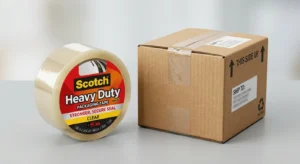
Use a suitable closure for the outer shipping container. Decorative stickers can support presentation, but they should not be assumed to provide adequate shipping security.
For wholesale deliveries, organize individual cartons inside master cases with appropriate support. The outer case protects several retail packages during transport and warehouse handling.
8. US Labeling and Recycling Guidance
Apparel labels and package information
The Federal Trade Commission explains that most covered textile products require fiber content, country of origin, and responsible business identification. Hats have different coverage: hats are excluded from the Textile Act requirements, but hats containing wool fall under the Wool Act.
Hoodies covered by the Care Labeling Rule need care instructions. If packaging hides the care label from shoppers, that information must appear on the package exterior or an attached hang tag. Hats are excluded from this rule’s definition of textile wearing apparel.
For inventory, add practical identifiers such as size, color, SKU and barcode. Do not treat a decorative box label as a substitute for required garment labeling.
Recycling claims need evidence
Paperboard recycling depends on the complete package and available collection systems. Coatings, windows, attached accessories and other components can affect acceptance.
EPA’s US data reported a 20.8 percent recycling rate for paper containers and packaging excluding corrugated boxes in 2018. This is historical national data, not a current recycling rate for hoodie cartons.
The FTC’s Green Guides call for qualified recyclable claims if suitable recycling facilities are unavailable to at least 60 percent of consumers or communities where the package is sold.
Ask suppliers for evidence supporting recycled content claims. Give customers disposal instructions that reflect the actual materials.
9. Bulk Orders, Suppliers, and Packaging Costs
Compare the complete order cost
Hoodie and hat packaging bulk purchases can lower unit prices, but larger quantities tie up cash and storage space.
Request quotes covering board grade, dimensions, inserts, printing, finishes and delivery. Include tooling, samples and assembly labor in the comparison. An affordable carton can become expensive if it takes too long to assemble or causes damaged orders.
Approve samples before production
Ask hoodie and hat packaging suppliers about minimum quantities, production schedules and quality checks. Confirm whether artwork changes require new plates or tooling.
Review a physical sample with the actual apparel set. Keep an approved reference for checking later deliveries.
For US sourcing, confirm where printing and converting occur rather than relying on the supplier’s office address. Clear specifications make packaging orders easier to compare and repeat.
Hoodie and Hat Packaging Questions and Answers
What paperboard packaging is best for a hoodie and hat?
A divided folding carton suits many retail sets. A rigid box suits gift presentations. Shipping may require a protective outer container. The best choice depends on product shape, weight, handling and budget.
Can a hoodie and baseball cap share one box?
Yes. Give the cap its own supported space and keep hoodie pressure away from the crown and visor. Test the packed set before ordering production quantities.
Should hoodie and hat packaging match?
Matching colors, typography and artwork help customers recognize the set. The compartments can use different shapes to protect each product properly.
Can hoodie and hat packaging be recycled?
Some paperboard packages can enter local paper recycling programs. Check the board, finishes and attached components against local acceptance rules before making a claim.
How can a business reduce packaging costs?
Limit unnecessary finishes, standardize tested carton sizes and order quantities that suit actual demand. Compare total packing and shipping costs rather than the empty box price alone.