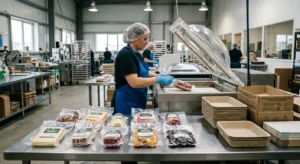
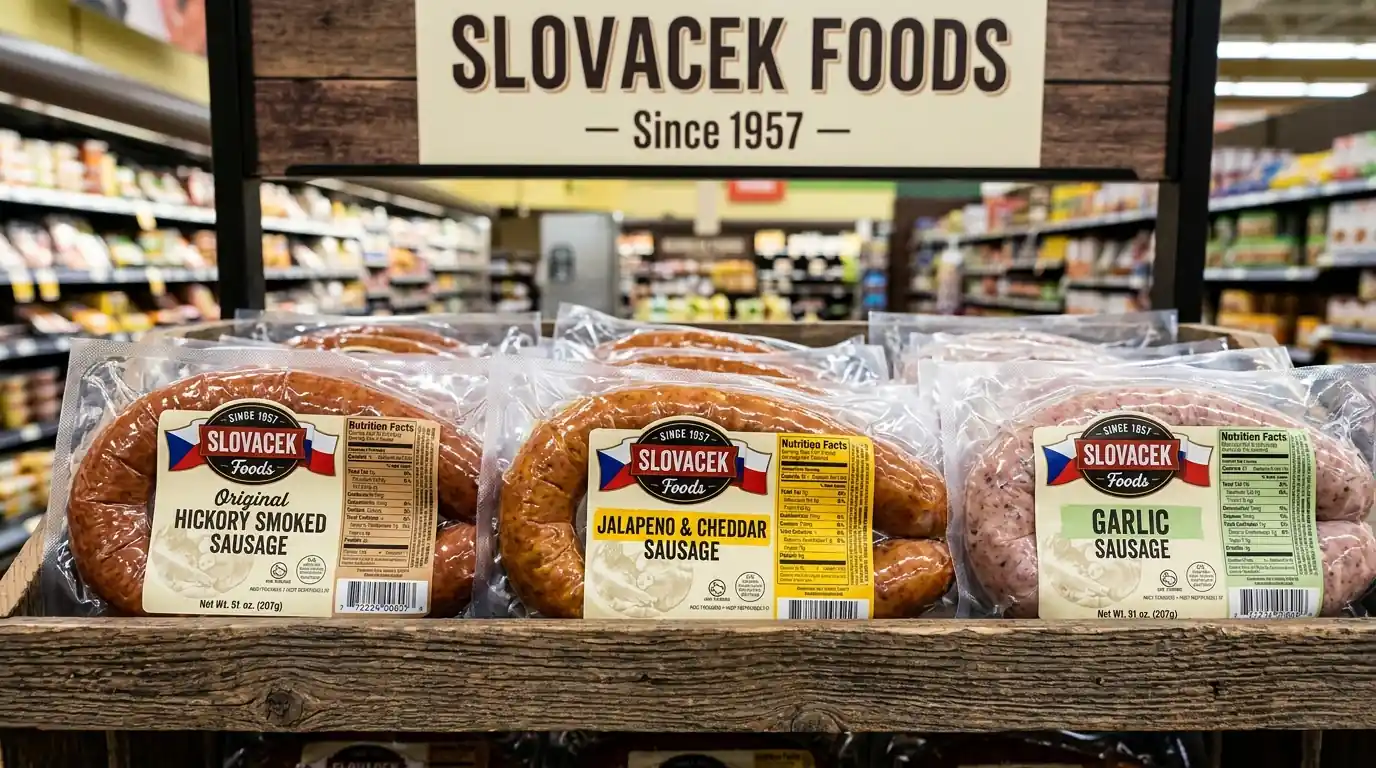
Paperboard packaging plays several roles in meat merchandising and distribution. It supports sealed food packs, provides printable space, groups products, and helps protect merchandise during handling. For readers researching Slovacek Foods packaging supplies, separating these functions makes purchasing decisions more practical.
Slovacek identifies its Snook, Texas, operation as a producer of fully cooked smoked sausage distributed through retail and foodservice wholesalers. The packaging options discussed here are planning recommendations for that product category, rather than a verified catalog of its packaging supplies or approved vendors.
What Paperboard Packaging Does for Sausage Products
Paperboard provides structure and communication around a food package. A sleeve can hold printed information around a sealed tray, and a folding carton can group several individually wrapped products. The food barrier and the outer paperboard serve different purposes.
Ordinary paperboard does not replace a validated primary package for refrigerated meat. Moisture control, oxygen protection, seal integrity and food contact suitability depend on the complete packaging system.
Primary, Secondary and Shipping Packaging
Primary packaging directly contains the food. Secondary packaging groups or supports the primary package, often adding graphics and handling convenience. Shipping packaging protects the grouped products through distribution.
For example, a sealed sausage pouch might sit inside a printed paperboard carton, with several cartons packed into a corrugated case. This is a possible structure, without implying that Slovacek uses that exact arrangement.
Paperboard Packaging Supplies Worth Evaluating
A useful supply list starts with the product format and sales channel. Retail packs, wholesale cases and prepared food service each place different demands on paper based materials.
Common options include:
- Printed paperboard sleeves for sealed trays or pouches.
- Folding cartons for individual packs or product assortments.
- Paperboard trays with barriers suitable for their intended application.
- Inserts, partitions and support cards.
- Corrugated shipping cases and pallet layer sheets.
These components should be specified together. An attractive carton offers limited value if it fits poorly inside the distribution case.

Printed Sleeves for Sealed Food Packs
Sleeves provide a large printing area with relatively little board. They can expose part of the primary package so shoppers can view the product. Their dimensions should account for package variation and chilled storage conditions.
The sleeve must remain secure without squeezing the sealed pack excessively. Sleeve sizes depends on the filled package dimensions, rather than the empty pouch alone.
Folding Cartons and Multipack Boxes
Folding cartons can organize several sealed packs into one retail unit. They provide space for product information, preparation directions and assortment details.
Closure options include tuck flaps, glued ends and locking structures. The correct choice depends on weight, assembly equipment and the expected opening experience. A heavier assortment may need more support across the bottom panel.
Choosing the Right Paperboard Grade
Board selection affects stiffness, printing, converting and storage performance. Color and thickness provide useful clues, but they do not establish a complete performance specification.
Solid bleached sulfate, commonly called SBS, offers a white printing surface. Coated recycled board can suit certain secondary packaging applications. Unbleached grades provide a brown fiber appearance and may fit particular structural or visual requirements.
Caliper, Grain Direction and Creasing
Caliper describes board thickness. Grain direction influences folding behavior and dimensional movement as moisture conditions change. Crease design helps the board fold without excessive surface cracking.
A thick board is not automatically the best choice. Poor scoring can make a carton difficult to assemble, and an unsuitable grade may lose stiffness in refrigerated conditions.
Recycled Fiber and Food Contact
Recycled content can support material sourcing goals. Its suitability for direct food contact depends on the material composition, intended food and applicable requirements.
For an outer carton around a sealed pouch, the exposure conditions differ from those of a tray holding sausage directly. Document the actual application rather than relying on a broad “food grade” description.
Grease Resistance and Moisture Protection
Sausage packaging may encounter fat, condensation and occasional leakage from damaged primary packs. Paperboard needs appropriate resistance for the exposure it will experience.
A secondary sleeve may require scuff resistance and tolerance of condensation. A direct contact tray requires a more detailed review of its barrier, seams and food contact surfaces. These are really different jobs.
Barrier Coatings and Laminations
Aqueous coatings, polymer layers and other barrier systems can reduce absorption under specified conditions. Their suitability depends on food composition, temperature, contact duration and converting methods.
Coated board still has potential weak points. Cut edges, folds and corners can absorb moisture or expose the underlying fibers. The exposed edges needs attention during sample testing.
Current U.S. PFAS Considerations
In January 2025, the FDA announced that 35 food contact notifications related to certain PFAS substances were no longer effective following abandonment of their uses. Those uses involved grease resistance in paper and paperboard food packaging. Supplier documentation should reflect the current regulatory position.
Ask what barrier chemistry is used and what evidence supports any PFAS related claim. A vague statement on a quotation does not explain the material composition or testing basis.
Refrigerated and Frozen Packaging Performance
Cold storage creates conditions that ordinary dry storage testing may miss. Condensation can soften board, weaken adhesive bonds and affect label adhesion. Repeated handling can then damage corners or closures.
For frozen applications, evaluate performance across the intended freezing, storage and handling conditions. A carton approved for refrigerated distribution should not automatically be treated as suitable for extended frozen storage.
Paperboard Is Not Refrigeration
A folding carton provides limited thermal protection. Safe temperature control depends on the product requirements and the validated storage or shipping system.
Shipments needing temperature management may require insulation and refrigerants in addition to outer packaging. Confirm compatibility between those materials and the paperboard components. Wet refrigerant contact can create a packaging problem very quickly.
Corrugated Cases for Wholesale Distribution
Corrugated fiberboard differs from solid paperboard. Its fluted medium between liners provides a structure suited to many shipping applications. The grade and case construction should match the load and distribution conditions.
Useful specifications include inside dimensions, flute profile, wall construction and strength rating. Product weight, pallet stacking, storage duration and humidity all influence the final choice.
Case Strength and Pallet Layout
Edge Crush Test ratings describe the edgewise compression resistance of corrugated board. They do not establish a universal maximum product weight for every finished box.
Evaluate assembled cases under representative loading conditions. Avoid pallet overhang and unsupported carton edges. A pallet layout that looks efficient on a drawing may still leave vulnerable areas under compression.
Inserts, Dividers and Support Components
Paperboard inserts can keep sealed packs organized inside cartons. They may separate different varieties, support a display arrangement or reduce movement during transit.
Support cards can provide stiffness beneath flexible packs. Their edges should not damage the primary packaging. Check for rubbing, sharp corners and pressure near seals.
The inserts keeps the presentation consistent, which can reduce the need for staff to rearrange products after opening a case. That benefit is simple, but useful.
Printing and Information Layout
Food packaging must communicate clearly at the point of sale and during handling. Paperboard provides room for product identity, preparation directions, storage statements and business information.
Printing methods may include offset, flexographic or digital production, depending on the component and order quantity. Select finishes that tolerate the expected moisture and abrasion.
Readability, Barcodes and Product Windows
Keep text away from folds, glue seams and areas likely to wrinkle. Barcodes need sufficient contrast and a surface that scanners can read reliably.
Windows can expose the primary pack, but they remove structural material from the carton. A window without added film may reduce material combinations, provided the opening does not compromise protection.
U.S. Food Packaging Documentation
Food contact packaging needs evidence supporting its intended use. For meat products, FDA material requirements and USDA Food Safety and Inspection Service oversight both have relevant roles.
Under 9 CFR 317.24, packaging materials must be safe for their intended use. Materials entering an official establishment must be accompanied or covered by a supplier guaranty or statement of assurance meeting the regulation’s requirements.
What to Request From Suppliers
A purchasing file should contain enough detail to identify the supplied material and its limitations.
Request documentation covering:
- Board grade, caliper and component construction.
- Intended food contact conditions.
- Coating, adhesive and printing specifications.
- Relevant compliance statements.
- Material identification and change notification procedures.
Keep these records connected to the actual supply item. Documentation for a similar board is not necessarily documentation for the finished printed package.
Meat Product Labeling and Traceability
Label requirements depend on the product and package function. Retail meat labels may need product identity, ingredients, applicable allergen information, net weight, inspection information and other required statements.
Preparation and handling statements must match the product’s status. Fully cooked products and products requiring cooking should not receive interchangeable instructions. Review the applicable FSIS labeling guidance before artwork approval.
Lot Codes and Case Identification
Lot codes help connect finished goods with production records. Outer cases should support receiving, inventory rotation and withdrawal procedures.
Reserve readable space for variable information such as batch identifiers and dates. Coatings can affect ink adhesion, so test coding on the finished surface.
Testing Before a Large Order
Physical samples reveal problems that a flat drawing can miss. Evaluate fit, closure strength, packing speed and print readability with actual filled products.
A trial should include relevant moisture exposure, storage conditioning and distribution handling. Check the primary package after testing, rather than judging the outer carton alone.
Practical Inspection Points
Inspect for:
- Carton distortion and softened corners.
- Cracked folds or separating layers.
- Loose sleeves and weak adhesive joints.
- Scuffed graphics or unreadable codes.
- Damage to pouches, trays or their seals.
The trial samples shows whether the selected structure works on the packing line. Sometimes a small dimensional adjustment saves more than adding extra board.
Purchasing Costs and Inventory Planning
Compare total packaging cost, including components, printing setup, tooling, freight, storage and packing labor. A lower unit price can become expensive if it creates excess waste or slows assembly.
Standard sizes can be affordable for smaller orders. Custom dimensions may reduce wasted space across repeated shipments. One should compare those savings with tooling charges and inventory commitments.
Ordering and Supplier Change Control
Provide an accurate specification before requesting quotations. Include quantities, delivery schedules, approved artwork and testing expectations.
Ask for a accurate explanation of minimum order quantities and repeat order charges. Require notification before changes to board, coatings or adhesives. A material substitution can affect performance without changing the package appearance very much.
Recycling and Packaging Waste
Paperboard recovery depends on the complete package construction and local collection rules. Heavy food residue, certain barriers and attached materials can affect acceptance.
Make separation instructions practical. A paper sleeve around a sealed pouch may be easier to separate than a permanently bonded material combination, but local recycling acceptance still needs checking.
Reducing unnecessary board and empty space can lower purchasing costs. Protecting the food remains part of that calculation, since damaged or discarded products carry costs beyond the carton.
Frequently Asked Questions
Does Slovacek Foods sell packaging supplies?
The official material reviewed identifies sausage production and distribution. It does not establish a public packaging supply catalog. Confirm availability directly before treating any listed packaging format as an item sold by the company.
Can paperboard directly hold sausage?
It can serve that role only with a suitable structure and materials validated for the intended contact conditions. Ordinary printed carton board should not be assumed suitable.
Can a paperboard box extend shelf life?
A secondary carton alone does not establish shelf life. Shelf life depends on the food, primary packaging, processing, storage conditions and supporting validation.
What should buyers approve before production?
Approve the material specification, filled package fit, artwork, documentation and tested sample. Keep a reference sample so later deliveries can be compared with the agreed result.