
A package can reveal more than its sender expects. Product photographs, category names, colorful graphics, and printed descriptions may tell neighbors or coworkers what someone ordered before the recipient opens it. Discreet packaging limits these visible clues through plain surfaces, enclosed structures and thoughtful labeling.
Paperboard offers practical options for this purpose. Folding cartons, sleeves, partitions, and opaque panels help keep products covered without making the packaging complicated. The best approach connects privacy with product protection, manageable costs and a comfortable opening experience.
What Is Discreet Packaging?
Discreet packaging uses an understated exterior that does not openly advertise the contents. A typical example is a plain paperboard carton with no product image, promotional message, or revealing category description.
The package still carries necessary delivery information. Recipient details, tracking barcodes and required markings remain readable. Privacy comes from limiting unnecessary disclosure rather than removing information needed for safe, accurate delivery.
Discreet Versus Discrete Packaging
“Discreet” means careful about privacy or attracting attention. “Discrete” means separate or distinct. Discreet packaging is the correct term for a plain box intended to keep an order private.
Plain packaging and discreet packaging overlap, but they are not identical. A blank carton with a revealing sender name can still expose the product category. Genuine discretion requires reviewing the entire visible package.
Why Customers Request Discreet Packaging
Privacy matters for ordinary purchases, sensitive products and surprise gifts. A customer may simply prefer that personal shopping decisions stay personal.
Plain packaging can reduce visible clues about valuable contents, but it cannot guarantee theft prevention. Delivery location, handling practices and collection arrangements still affect security.
Comfort and Confidence
People ordering intimate care products, health accessories or personal grooming items may feel uncomfortable receiving recognizable packaging at work or in shared housing. A neutral carton gives them more control over who sees their purchase.
For the customer, this is very practical. They can receive an order without explaining it. That small convenience can support confidence in the seller and make another purchase feel easier.
Gifts and Unrevealed Purchases
Gift packaging benefits from the same privacy. A plain outer carton keeps a birthday present or jewelry purchase from being identified at the door.
The privacy benefit is really simple: the package reaches the recipient without giving away the surprise. The decorative experience can begin inside.
Paperboard Materials for Discreet Packaging
Paperboard is thicker and stiffer than ordinary paper. Folding cartons can be produced from virgin or recycled board grades and supplied flat before assembly. Common grades include SBS, CUK, CRB, and FBB.
Material selection should reflect product weight, carton dimensions, appearance, storage conditions and the distribution route. A plain surface alone says little about structural performance.
Solid Bleached Sulfate
Solid bleached sulfate, commonly called SBS, offers a white surface suited to printed instructions and interior graphics. It can support a plain exterior with more detailed printing inside.
White paperboard is not automatically less discreet than brown board. Opacity, graphics and labeling matter more than the surface color by itself.
Kraft and Recycled Paperboard
Kraft paperboard offers a natural brown appearance that works well for understated packaging. Coated unbleached kraft, or CUK, is another grade a supplier may propose for suitable structural applications.
Coated recycled board, called CRB, can suit many secondary packaging uses. Request samples to evaluate stiffness, surface quality and odor suitability rather than choosing a grade from its name alone.
Thickness and Opacity
Board caliper measures thickness. In common packaging terminology, 18 point board is approximately 0.018 inch thick. Thickness does not directly establish load capacity; fiber composition, folds, dimensions and humidity influence performance.
Test opacity under strong lighting with the actual product inside. Thin panels, open seams or loose flaps can reveal outlines that were not obvious on an empty sample.
Paperboard Box Styles That Support Privacy
Carton structure affects how well the contents stay hidden during storage, handling and opening. Choose the closure around the product rather than selecting a familiar style without testing it.
Tuck End Cartons
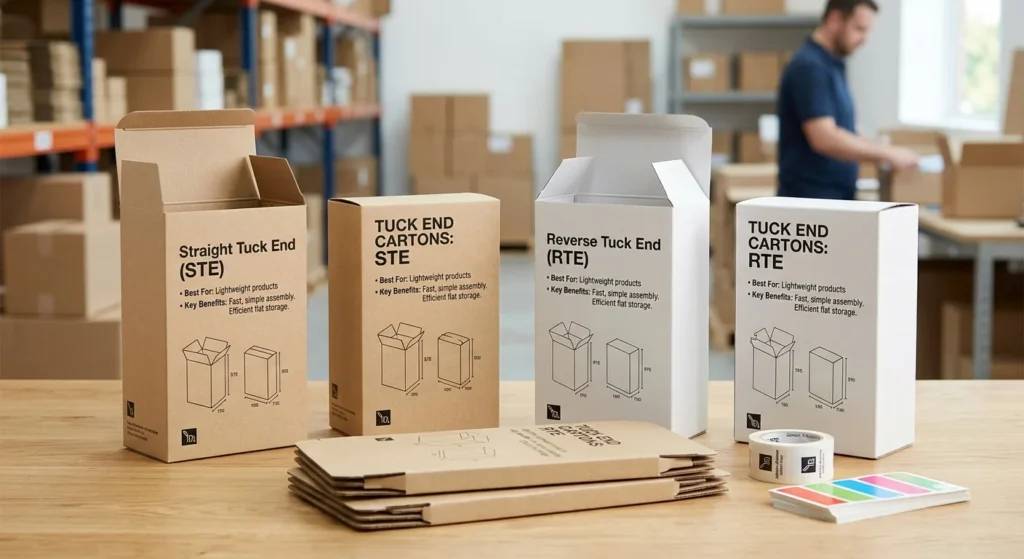
Straight tuck end and reverse tuck end cartons suit many lightweight products. Their flaps make assembly straightforward, and the cartons can be stored flat.
A tuck flap is not a security seal. Adhesive labels or another suitable closure may be needed to provide visible evidence of opening.
Lock Bottom and Automatic Bottom Cartons
Lock bottom cartons use interlocking bottom panels. Automatic bottom cartons have a glued bottom structure that opens into position during assembly.
Both styles can support efficient packing. Their suitability depends on product weight and the tested carton design, particularly around the bottom corners.
Sleeves and Two Piece Boxes
A paperboard sleeve can conceal graphics on an inner product carton. Its open ends need attention, since exposed ends may reveal product names or identifying colors.
Two piece boxes provide a separate lid and base. For valuable gifts, a plain outer carton can conceal a more decorative presentation box inside.
Product Applications for Discreet Paperboard Packaging
Different products create different privacy concerns. A useful packaging specification identifies what could reveal the contents and what could damage them.
• Intimate wellness products: Use opaque panels, neutral exterior printing and fully covered openings.
• Menstrual and incontinence products: Check bulk, panel stiffness and closure strength.
• Personal care and grooming products: Secure bottles, jars and accessories against movement.
• Cosmetics and skin care: Keep product graphics inside the outer carton and evaluate leakage risks.
• Jewelry and small gifts: Use fitted inserts without exterior value statements.
• Supplements and wellness accessories: Keep required product information on the appropriate inner packaging.
• Small electronics: Provide fitted support and address any applicable battery shipping requirements.
• Subscription orders: Use consistent plain cartons with the personalized presentation inside.
One product family may need several carton sizes. Forcing every order into the same box often creates wasted space or inadequate protection.
Exterior Design and Interior Printing
The outer panels stays plain, with minimal visible clues about the purchase. Avoid product silhouettes, descriptive slogans, transparent windows and decorative cutouts.
Brown, white, gray or another neutral color can work. Bright tape, recognizable patterns and category related artwork may undo the effect of an otherwise plain carton.
Put the Experience Inside
Interior printing provides space for a welcome message, care instructions, product information or return guidance. A printed inner panel can make opening the package feel considered without advertising the order outside.
Digital printing may suit small quantities or changing artwork. Offset printing may suit larger runs. Compare quotations using the same board, dimensions and print coverage rather than assuming one process always costs less.
Coatings and Finishes
A suitable coating can help resist handling marks, but ordinary coated paperboard should not be treated as waterproof. Water, abrasion and fold testing should match the expected conditions.
Foil, embossing and decorative finishes are optional. They can add expense and draw attention on the exterior. A restrained finish is often enough for a private delivery.
Inserts, Closures and Product Protection
Privacy can fail after a flap opens or a product breaks through a panel. Structural support deserves as much attention as exterior artwork.
A fitted paperboard insert can separate components, limit rattling and hold a product away from vulnerable corners. Folded partitions work well for some sets containing several items.
Control Movement Inside the Carton
Empty space allows products to shift. Too little clearance can make packing difficult or place pressure on a bottle cap, fragile edge or closure.
Measure the product with its cap, pump, accessories and protective wrapping included. Test the packed sample by handling it in several orientations.
Use Appropriate Seals
Tamper evident labels, glued closures and tear strips can provide evidence that a carton was opened. None should be described as tamper proof.
A secure inserts helps prevent movement, but closure strength needs its own check. The bottom seam and top flap should remain closed throughout the intended handling process.
Discreet Packaging and Shipping Protection
A folding carton that works on a retail shelf may not survive parcel delivery by itself. Parcel systems expose packages to compression, drops, vibration and contact with other shipments.
For fragile or heavier products, place the paperboard carton inside an appropriate protective shipping container. The paperboard carton remains the focus of the product presentation and privacy system.
Evaluate the Complete Package
Test the product, inserts, carton and shipping container together. An empty box test does not reveal every weakness in the finished shipment.
Odor containment needs separate attention. Ordinary paperboard is not an airtight odor barrier, and a plain carton does not prevent fragrance or other smells from escaping. Any necessary barrier belongs in a compatible inner packaging system.
Labels and Fulfillment Practices
Small details matters when the box reaches the packing station. A neutral carton can still disclose its contents through an exterior packing slip or a revealing label description.
Use a truthful sender identity and return address that satisfy applicable requirements. Review visible order references, product names and service descriptions before approving the label layout.
Keep Sensitive Details Inside
Put invoices, itemized packing slips and promotional inserts inside an opaque package. Warehouse codes should support order accuracy without unnecessarily displaying sensitive product descriptions.
Internal stock keeping units, often called SKUs, need consistent handling. A plain carton is helpful only if the correct item and documents reach the correct recipient.
Maintain Discretion Through Returns
Return labels, replacement orders and exchanges deserve the same review as the original delivery. A privacy policy loses value if the replacement arrives with revealing graphics.
Train packing staff with physical examples. Show which carton, insert, seal and paperwork placement belong to each product family.
Required Information Cannot Be Hidden
Discreet packaging must retain applicable safety markings and accurate shipping documentation. Hazardous material labels, required shipping names and identification numbers may need to appear on the exterior according to the shipment requirements.
International shipments may require accurate customs descriptions. Do not replace a required description with a vague or misleading term just to conceal the contents.
A plain outer carton does not replace required product labeling or regulated packaging features. Confirm the requirements for the actual product and destination before production.
Sustainability and Packaging Costs
Recycled content, efficient dimensions and removable inserts can support material reduction goals. Excessive board thickness and oversized cartons can increase material use without improving the package enough to justify it.
Environmental claims need evidence. Recyclability depends on the complete packaging structure and access to suitable collection systems, not simply on the presence of paper fibers. Broad environmental promises should be avoided without support.
What Affects the Price?
Carton dimensions, board grade, print coverage, tooling, finishing and order quantity influence cost. Packing labor, storage and damage rates belong in the comparison too.
Plain printing may offer an affordable approach, but inserts and special closures can add expense. The best value is a carton that performs reliably at a practical total cost.
How to Order Discreet Paperboard Packaging
Give the converter a clear specification and request a physical sample. Describe the product and handling conditions rather than asking for a “strong plain box” without measurements.
- Record product dimensions, weight and fragile areas.
- Choose the carton structure and proposed board grade.
- State exterior privacy requirements.
- Confirm inserts, seals and interior printing.
- Review labels and required markings.
- Test a fully packed sample.
- Approve artwork, dimensions and production tolerances.
These check helps prevent avoidable surprises. Keep an approved sample for future orders so changes in fit or closure performance are easier to spot.
Questions About Discreet Packaging
Is Discreet Packaging Completely Anonymous?
No. Delivery information remains visible, and required documentation may identify the sender or contents. Discreet packaging limits unnecessary disclosure.
Can a Paperboard Carton Be Discreet Without Being Brown?
Yes. White and other opaque paperboard cartons can provide privacy. Graphics, openings and visible information determine how revealing the package is.
Does Plain Packaging Cost Less?
It can cost less if printing and decoration are reduced. Structural requirements, quantity, inserts and packing labor still influence the final price.
Is Discreet Packaging Suitable for Every Product?
Many products can use a discreet exterior. Some need special protection, barriers or mandatory markings. Start with those requirements, then build privacy into the paperboard packaging around them.