
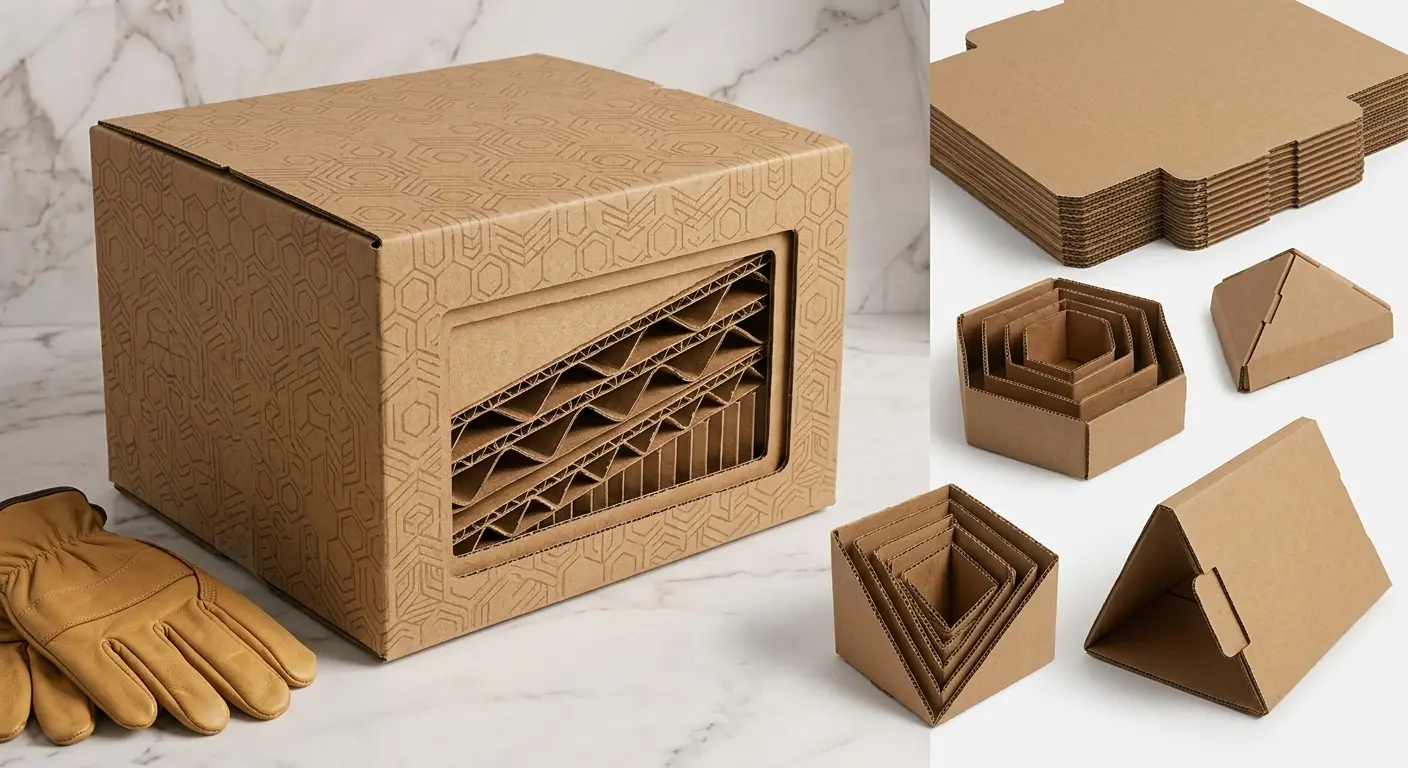
Corrugated packaging boxes support a large part of industry retail, manufacturing, food distribution, and online shopping. Their layered paper structure provides protection without adding excessive shipping weight. For businesses buying packaging, the real value comes from matching the board, box style and internal protection to the product.
A good box does more than hold merchandise. It supports warehouse stacking, carries product information, and helps an order arrive ready for use. Getting those details right can reduce damage claims and make packaging costs more manageable.
What Are Corrugated Packaging Boxes?
Corrugated boxes are paper based packaging containers made from linerboard and a fluted paper medium. The medium forms a series of arches between flat liners, creating thickness and resistance to compression. These arches help the material absorb certain impacts and carry stacking loads.
People often call this material cardboard, but cardboard is a broad everyday term. Corrugated fiberboard differs from solid paperboard used for many cereal cartons, cosmetic sleeves and lightweight retail packages. Both belong to paper packaging, yet their structures and performance differ.
How Corrugated Board Is Manufactured
Paper passes through heated corrugating rolls that form the fluted medium. A starch based adhesive bonds the flute tips to linerboard, producing continuous sheets. The sheets are then cut, scored, printed and converted into boxes.
Paper quality, adhesive bonding, flute formation, and converting conditions affect the finished package. Board thickness alone cannot tell you whether a box will perform well.
Corrugated Board Types and Wall Construction
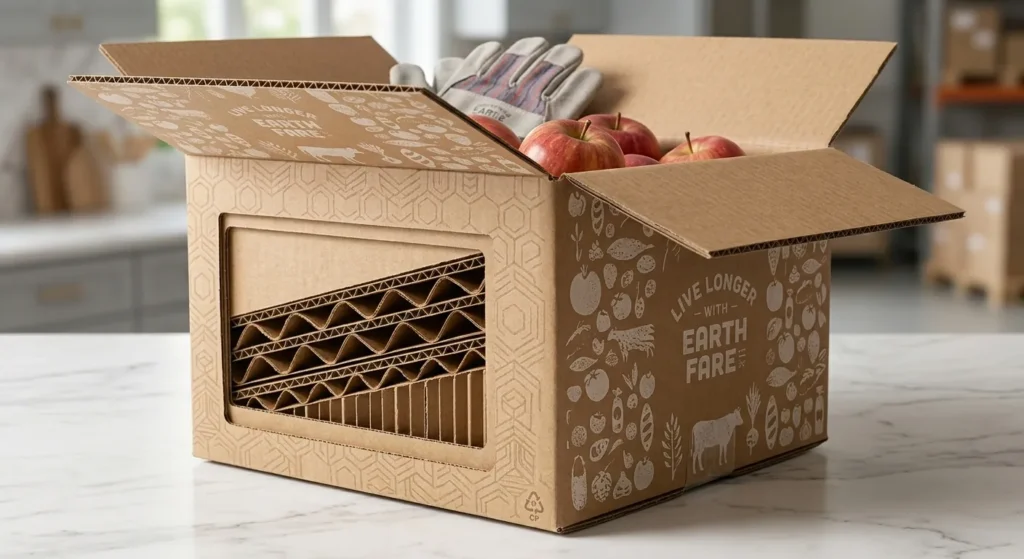
Wall construction describes how many layers of fluted medium and linerboard form the board. More layers can provide greater protection, with added material, weight and expense.
- Single face board: One fluted medium bonded to one liner, often used for wrapping or cushioning.
- Single wall board: One fluted medium between two liners, suitable for many shipping cartons and mailers.
- Double wall board: Two fluted mediums between three liners, commonly used for heavier or more demanding shipments.
- Triple wall board: Three fluted mediums between four liners, used for selected industrial loads and bulk containers.
Single wall board is a practical starting point for many products. Double wall construction may suit dense components, larger containers, or shipments exposed to greater stacking pressure. The final choice should follow testing with the actual contents.
Kraft and Recycled Linerboard
Brown kraft liners provide a familiar shipping appearance. White liners offer a lighter printing surface for graphics and product information. Recycled linerboard uses recovered paper fibers, with available grades covering many packaging applications.
Neither brown color nor recycled content establishes a strength rating. Ask for the board specification, test results and material documentation.
Flute Types and Their Packaging Uses
Flute size affects board thickness, cushioning, folding behavior, and printing quality. A taller flute can provide more cushioning space; a smaller flute often supports finer graphics and compact folds.
A, B and C Flutes
A flute provides substantial thickness and cushioning for suitable applications. B flute has a thinner profile and good resistance to flat crushing, making it useful for certain trays, retail packs and shipping boxes. C flute offers a common balance of cushioning and stacking performance.
The best flute depends on the entire package. A fragile glass item needs more analysis than simply selecting the thickest board.
E and F Flutes
E flute suits many printed mailers, subscription boxes, and retail packages. F flute provides an even thinner profile for smaller packages needing detailed printing and compact construction.
Combined flute structures, such as BC or EB board, bring different profiles into double wall packaging. Flute letters describe geometry, rather than a guaranteed load capacity.
Common Corrugated Box Styles
Box construction influences assembly speed, material consumption, closure requirements and product access. Using one style for every product can create avoidable costs.
Regular Slotted Containers
A regular slotted container, commonly called an RSC, has four top flaps and four bottom flaps. The major flaps meet near the center when closed. This format works well for many shipping, storage and distribution applications.
RSC boxes are often economical to manufacture and ship flat. Tape or another suitable closure secures the top and bottom.
Mailers, Trays and Telescoping Boxes
Corrugated mailers use interlocking panels and a hinged lid to create a convenient opening experience. Trays support produce, beverage packs, retail displays and grouped products. Telescoping boxes use separate sections that slide over one another.
Full overlap containers provide extra material across the opening. Long cartons, book wraps, and partitioned cases serve products with more particular handling needs.
How to Choose Box Strength
Box strength must account for product weight, stacking height, storage time, humidity and transportation conditions. A package that performs well during a short delivery may struggle after weeks under a warehouse load.
Edge Crush Test and Bursting Strength
The Edge Crush Test, or ECT, measures the edgewise compression resistance of corrugated board. An ECT rating helps evaluate stacking potential, but it does not state the maximum product weight a finished box can carry.
Bursting strength measures resistance to rupture under increasing pressure. Neither measurement fully predicts puncture damage, drop performance or the behavior of a complete package.
Box Compression Testing
A box compression test measures the compressive resistance of an assembled container. Dimensions, closures, openings, flute direction and manufacturing quality all influence the result. The dimensions affects how compression loads move through the package.
Hand holes and display cutouts deserve attention. These panels needs enough remaining material to carry the expected load.
Box Sizes, Product Fit and Shipping Costs
Corrugated box dimensions are commonly listed as length, width and depth. Confirm whether a quote uses inside dimensions or outside dimensions. Inside measurements determine usable product space; outside measurements matter for shipping and pallet planning.
Measure the product in its shipping condition, including wrapping, dividers and protective pads. Leave appropriate cushioning space without creating excessive empty volume.
Why Dimensional Weight Matters
Parcel shipping charges may reflect dimensional weight rather than actual weight. A large, light package can occupy expensive transportation space. Carrier formulas and contract terms vary, so use the applicable shipping agreement for calculations.
A smaller suitable carton can reduce board usage, filler consumption and storage demand. That benefit repeats across every shipment, which is really where the savings become visible.
Inserts, Dividers and Product Protection
The outer carton and internal protection should work together. A strong box cannot prevent damage if the product moves freely inside it.
Paper based options include corrugated partitions, folded inserts, molded pulp supports, pads and paper cushioning. The right inserts keeps separate products from knocking against one another during transit.
For bottles or jars, dividers reduce direct contact. For electronics, fitted supports can limit movement, but ordinary corrugated board does not provide verified electrostatic protection. Sensitive devices may need a separate protective system.

Printing and Custom Corrugated Packaging
Custom printed corrugated boxes can carry product details, handling instructions, graphics and disposal guidance. Printing decisions should match order quantity, artwork quality, board surface and available budget.
Flexographic, Digital and Lithographic Printing
Flexographic printing suits many production runs using text, logos, and limited color artwork. Digital printing supports variable content and smaller quantities without conventional printing plates. Lithographic printing with a laminated printed sheet can provide detailed imagery.
Heavy ink coverage and coatings can affect cost and recycling compatibility. Request a physical sample rather than judging color from a screen alone.
Artwork and Structural Details
Keep barcodes away from folds, seams and irregular surfaces. Give small text enough space, and place handling information where warehouse workers can see it.
A structural dieline identifies cut lines, scores, glue areas and panel positions. It should be reviewed with a accurate product sample before production approval.
Corrugated Boxes for Different Products
Different products create different risks. Packaging specifications should follow those risks rather than a generic description such as “heavy duty.”
- Food and produce: Ventilation, moisture exposure, grease resistance and intended food contact.
- Cosmetics and personal care: Leakage control, bottle separation and printed presentation.
- Glassware and ceramics: Individual cushioning, partitions and drop protection.
- Apparel and books: Suitable fit, surface protection and resistance to corner damage.
- Industrial components: Concentrated loads, abrasion, corrosion protection and pallet stability.
For frozen or refrigerated products, ordinary corrugated board is not an insulation system. Temperature sensitive shipments may require separate insulation, refrigerants and validated packing procedures.
Food Contact Requirements in the United States
Direct food contact requires material suitability for the food and intended conditions of use. Relevant federal provisions include 21 CFR 176.170 for certain aqueous and fatty food applications, and 21 CFR 176.180 for specified dry food applications. Compliance depends on the applicable substances and conditions, rather than a broad claim that every paper box is food safe.
Ask suppliers for documentation covering the intended application. Liners, coatings, adhesives and printing materials need appropriate review.
Moisture, Storage and Pallet Performance
Paper fibers absorb moisture, which can weaken corrugated structures. U.S. Forest Service research describes how moisture movement affects stiffness, deformation and compression behavior in corrugated fiberboard. Storage conditions belong in the packaging specification.
Store unused boxes in a dry area, away from standing water and direct floor contact. Protect bundles from crushing before assembly.
On pallets, avoid carton overhang and unsupported edges. Align loads according to the approved pallet pattern, and account for stretch wrap pressure. More wrapping is not automatically better if it crushes the corners.
Recycling and Environmental Claims
Corrugated packaging fits established paper recovery systems across much of the United States. The EPA estimated a 96.5 percent recycling rate for corrugated boxes in its 2018 national data. That historical estimate should not be presented as a current rate or a guarantee for individual packages.
Recycling acceptance depends on local programs and the package construction. Food residue, wax treatments, certain barriers and attached materials can affect acceptance. Flatten boxes and follow local collection instructions.
Making Practical Sustainability Choices
Reducing unnecessary material can lower both waste and purchasing costs. Recycled content may support material sourcing goals, provided the finished package still protects its contents.
A damaged product creates its own environmental burden. Balancing board usage with verified protection is more useful than choosing the lightest possible carton.
Buying Wholesale and Custom Corrugated Boxes
Compare suppliers using the same specification. A low unit price means little if the quote changes board grade, dimensions or printing coverage.
Request details covering:
- Inside dimensions and manufacturing tolerances.
- Board construction, flute profile and strength rating.
- Printing method, colors and surface treatments.
- Quantity, minimum order requirements and production timing.
- Tooling charges, freight, storage and replacement procedures.
Stock boxes suit standard needs and shorter purchasing cycles. Custom sizes may reduce wasted space, especially for products shipped repeatedly. Compare total delivered packaging cost, including labor, filler and damage losses.
Testing Before Production Approval
Evaluate a packed sample using realistic handling conditions. Depending on the distribution route, testing may include drops, vibration, compression and environmental conditioning. Appropriate ISTA procedures or ASTM methods can provide structured testing approaches.
Check product condition after testing, rather than checking the carton alone. Our samples shows useful problems that drawings can miss, including difficult assembly and excessive product movement.
Run a limited shipping trial before committing to a large order. Review damage, packing time, customer feedback and the condition of returned packages. Sometimes a small insert change saves more than a thicker outer box.
Frequently Asked Questions
Are corrugated boxes waterproof?
Standard corrugated boxes are not waterproof. Barriers can improve moisture resistance, but their performance and recycling compatibility require evaluation.
Can corrugated boxes be reused?
Yes, if their condition remains suitable for the next shipment. Inspect corners, scores, closures and any areas exposed to moisture. A carton used for two shipment may have damage that is easy to overlook.
Is double wall board always better?
Double wall board can provide greater strength, but it adds material and expense. A properly specified single wall package may satisfy the same distribution requirements.
What is the best corrugated packaging box?
The best box fits the product, supports the expected load and passes relevant testing at an acceptable total cost. Start with those requirements, then select the structure, material and print.