Moisture can damage a product before its paperboard carton shows any visible trouble. Metal accessories may develop corrosion, dry powders can form lumps, and sensitive components may lose performance during storage. Desiccant packaging helps manage these risks by controlling water vapor inside a suitable enclosure.
For US businesses, effective moisture protection starts with the complete package. A desiccant packet, protective liner, paperboard box, and sealing method must work together. Just adding a small sachet to an ordinary folding carton rarely provides dependable protection throughout a lengthy distribution cycle.
What Is Desiccant Packaging?
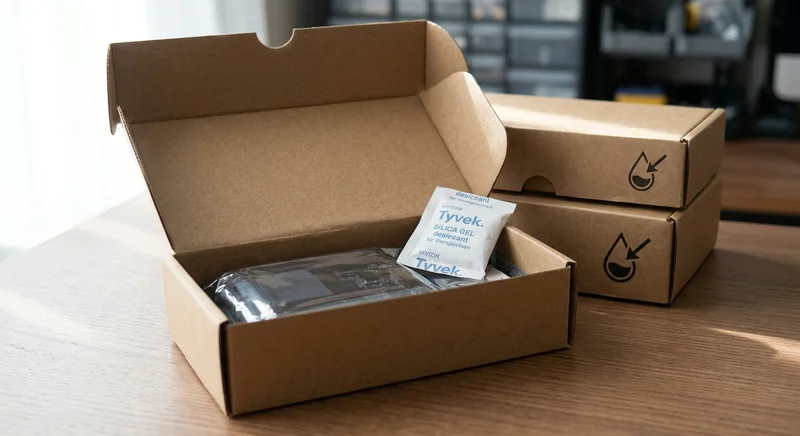
Desiccant packaging uses a drying material to capture moisture from the air surrounding a product. That material usually sits inside a breathable packet, sachet, bag, or canister that keeps its contents separated from the merchandise.
In paperboard packaging, the carton provides structure, printable surfaces and space for product information. The desiccant manages humidity within the protected enclosure. These are different jobs, and both deserve attention during package development.
A typical system may include:
- A folding carton or rigid paperboard box.
- A sealed inner pouch with suitable moisture resistance.
- A desiccant packet inside the pouch.
- A paperboard insert that holds the product securely.
- Clear handling and disposal instructions.
How Does a Desiccant Packet Work?
Adsorption and Absorption
Silica gel, activated clay, and molecular sieves capture water molecules through adsorption. Moisture attaches to surfaces within their porous structures. Absorption involves moisture entering the bulk of a material, and some drying agents operate through different mechanisms.
The distinction matters for material selection. Suppliers publish performance data for particular temperatures and relative humidity levels, so two packets with identical weights may offer different moisture capacity.
Relative Humidity and Dew Point
Relative humidity describes the amount of water vapor present compared with saturation at that temperature. A temperature drop can raise relative humidity inside a package and create condensation if a surface reaches the dew point.
Desiccants lower available water vapor within their working capacity. They do not repair leaking seals, remove standing water from wet products, or replace suitable storage conditions.
Why Paperboard Packaging Needs Moisture Planning
Paperboard is hygroscopic, meaning it exchanges moisture with surrounding air. Changes in moisture content can affect panel flatness, stiffness, dimensional stability and compression performance. USDA Forest Products Laboratory research links changing relative humidity with reduced strength and stability in loaded paperboard.
Folding cartons made from solid bleached sulfate, coated unbleached kraft, or recycled paperboard still need an application review. A thicker board may improve structural performance, but thickness alone does not establish water vapor resistance.
The outer carton provide useful protection during handling. Its seams, tuck flaps, and exposed edges can still allow moisture exchange with the environment.
The Role of an Inner Barrier
For sensitive products, a sealed barrier pouch creates a smaller space that the desiccant can manage. Placing the packet outside that pouch leaves it separated from the product atmosphere.
A coated carton or laminated paperboard structure may reduce moisture transmission. Its actual performance depends on the coating, joints, closures and exposed surfaces, so a glossy finish cannot serve as proof of a moisture barrier.
Types of Desiccants Used in Packaging
Silica Gel
Silica gel is a porous form of silicon dioxide used in many packet applications. It remains granular after taking up water vapor and provides useful capacity across suitable humidity conditions.
For retail products packed inside paperboard cartons, silica gel can be a practical starting point for evaluation. Review its capacity at the intended humidity rather than relying on the highest capacity advertised.
Activated Clay
Bentonite clay, including montmorillonite materials, offers an economical option for many storage applications. Its natural mineral structure captures moisture, and performance varies with environmental conditions.
Clay may be affordable for larger production runs. The purchase decision should include packet dimensions, adsorption rate, shipping weight, and the required protection period.
Molecular Sieves
Molecular sieves are crystalline materials, commonly synthetic zeolites, with controlled pore structures. They can provide strong moisture adsorption at low relative humidity, making them useful for products with demanding dryness requirements.
The best material depends on the target condition. Silica gel, clay and molecular sieves do not have identical capacity curves or adsorption rates.
Calcium Chloride
Calcium chloride is used in some larger moisture control systems. Certain formulations produce liquid brine as moisture is absorbed, requiring suitable containment.
For small retail cartons, leakage consequences need serious review. Never substitute a loose drying chemical for a validated packet system.
Choosing the Right Packet Material
The packet wrapper must admit water vapor and retain the desiccant particles. Paper, nonwoven materials, and suitable polymer structures offer different combinations of permeability, strength and particle containment.
A packet that resembles paper may contain plastic fibers or sealing layers. Ask for its material specification rather than making disposal decisions from appearance.
Review these characteristics:
- Water vapor permeability.
- Seal strength and puncture resistance.
- Dust release.
- Compatibility with the product.
- Suitability for manual or automatic insertion.
- Printing durability and warning visibility.
The wrapper influences adsorption speed, so the filling cannot be evaluated separately from its enclosure. A strong packet with poor vapor access may respond too slowly for the intended application.
How Much Desiccant Does a Paperboard Package Need?
Start With the Moisture Load
There is no dependable universal rule based only on carton dimensions. Moisture can come from trapped air, the product, inserts, paperboard components inside the barrier, and transmission through the enclosure over time.
The calculation needs the expected storage period, temperature exposure, target relative humidity and barrier performance. Repeated opening changes the moisture load again.
A larger packet do not fix a poor seal. It may simply reach saturation later.
Use Working Capacity
A practical estimate divides the anticipated moisture load by the usable moisture capacity per gram of desiccant. Add a justified allowance for variation, then test the finished package.
For an illustrative calculation, a 2 gram moisture load divided by a working capacity of 0.20 gram per gram requires 10 grams of desiccant before that allowance. Those numbers are examples, not a recommendation for a particular product.
Packet weight and desiccant units are different measures. A unit may represent performance under defined test conditions rather than a fixed weight, so compare supplier specifications carefully.
Packet Placement and Production Handling
Place the desiccant inside the same sealed enclosure as the item being protected. Leave enough exposure around its wrapper for water vapor movement, and keep it away from sharp corners that could tear the sachet.
Paperboard inserts can include a retaining pocket. Check that the pocket does not cover most of the breathable surface or place the packet under damaging pressure.
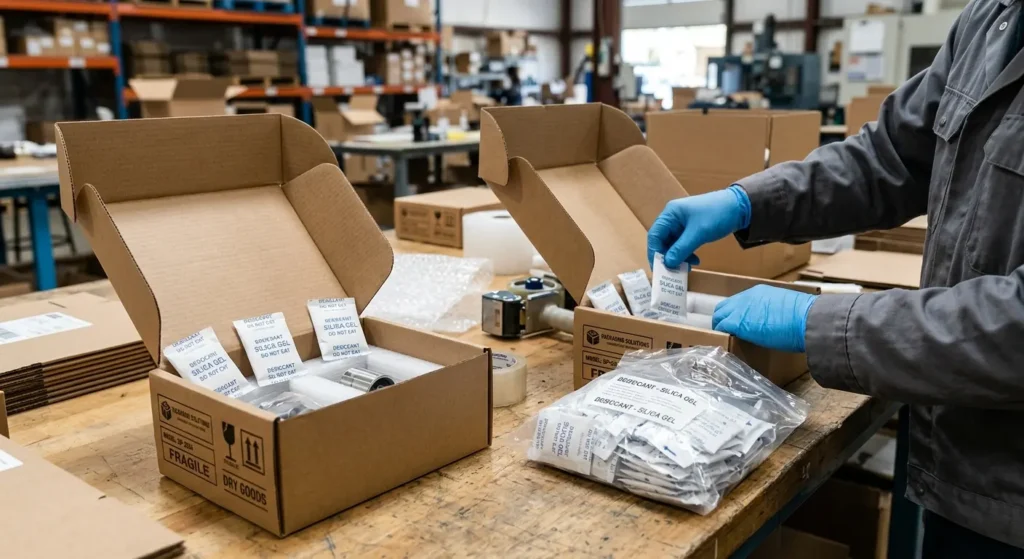
These packet should enter the package shortly before final sealing. Leaving supply containers open during a humid shift can consume useful capacity before shipment.
A practical packing sequence is:
- Verify the correct product, packet size and lot.
- Inspect the packet for damage.
- Insert it into the protected enclosure.
- Seal within the validated exposure period.
- Check packet presence and seal quality.
US Applications and Safety Requirements
Food and Dietary Supplements
Dry foods and powders may need protection against moisture uptake, clumping, or texture changes. The desired moisture condition must suit the product, since excessive drying can create quality problems too.
For US food applications, evaluate the entire packet construction and its intended contact conditions. FDA guidance addresses the regulatory status of individual food contact components, including their identity and permitted conditions of use. A broad “FDA approved” statement does not establish suitability for every application.
Request documentation covering the filling, wrapper, printing and seals. A desiccant is not a substitute for food safety controls or validated shelf life studies.
Electronics, Metal Parts and Medical Products
Electronics may require moisture barrier packaging combined with electrostatic discharge protection. A drying packet does not provide electrostatic shielding by itself.
Metal parts may need corrosion controls beyond humidity reduction, depending on surface condition and contaminants. Medical products require package and product compatibility review, including any effects on sterile barrier performance.
Consumer Warnings
Use visible handling statements such as “Do not eat” where appropriate. Keep loose sachets away from children and pets, and reject torn packets before packing.
A packet is not food, regardless of the appearance of its contents. Instructions should match the actual material and intended consumer use.
Testing Desiccant Packaging for US Distribution
Laboratory evaluation should represent the product’s expected route and storage conditions. A shipment passing through humid coastal facilities may face different exposure from one stored in a conditioned inland warehouse.
ASTM D4332 provides conditioning practices for containers, packages, and packaging components. It helps establish test environments, but it does not independently validate a desiccant dose or guarantee shelf life.
Measure internal humidity where useful, then inspect product condition, packet integrity, seals and carton performance. Combine moisture evaluation with relevant vibration, drop, and compression testing.
The test results gives a stronger basis for approval than carton appearance alone. Compare the proposed system against an appropriate control package to identify the benefit.
Storage, Cost and Sustainability
Store Packets Before Use
Keep unused desiccants in their original sealed protective containers under the supplier’s stated conditions. Record opening dates and follow limits for exposure during production.
One of the most common mistake is treating unopened shelf life as permission for unlimited open storage. A packet can look unchanged after taking up substantial moisture.
Do not heat packets for reuse without validated instructions. Wrapper materials, inks, seals and indicator chemistry may have different temperature limits.
Compare the Total Packaging Cost
Evaluate packet price alongside insertion labor, equipment needs, barrier material, testing and product losses. A slightly more expensive pouch may reduce moisture entry enough to change the required desiccant quantity.
For the buyer, the very cheap option is not always affordable after returns. Less moisture damage can mean fewer complaints and less replacement shipping, though those savings need actual business data.
Give Accurate Disposal Instructions
Separate the desiccant packet from paperboard before recycling where local instructions require it. Plastic liners, coatings, adhesives and packet construction can affect recovery options.
Avoid calling the complete system recyclable without supporting evidence. FTC guidance requires qualifications for recyclable claims under certain collection availability conditions.
Frequently Asked Questions
Can I Put a Desiccant Packet Directly Inside a Paperboard Box?
Yes, physical placement is possible. Reliable moisture protection usually requires a suitable enclosure with controlled moisture entry, so test the carton system before making performance claims.
Is a Desiccant Packet the Same as an Oxygen Absorber?
No. A desiccant manages moisture, and an oxygen absorber reduces oxygen under its specified operating conditions. One does not automatically replace the other.
Will Desiccant Packaging Stop Mold?
It may help maintain moisture conditions that discourage growth in an appropriate validated system. It cannot remove existing contamination or guarantee mold prevention in a wet product.
How Long Does a Packet Last?
Service life depends on moisture load, usable capacity, barrier performance and opening frequency. The packet’s weight alone cannot establish a reliable expiration period.
What Should US Buyers Request From a Supplier?
Request material specifications, adsorption data, packet dimensions, relevant compliance documentation and storage instructions. Share the product, enclosure construction, distribution conditions, and desired shelf life so the proposed desiccant packaging can be tested against a clear requirement.