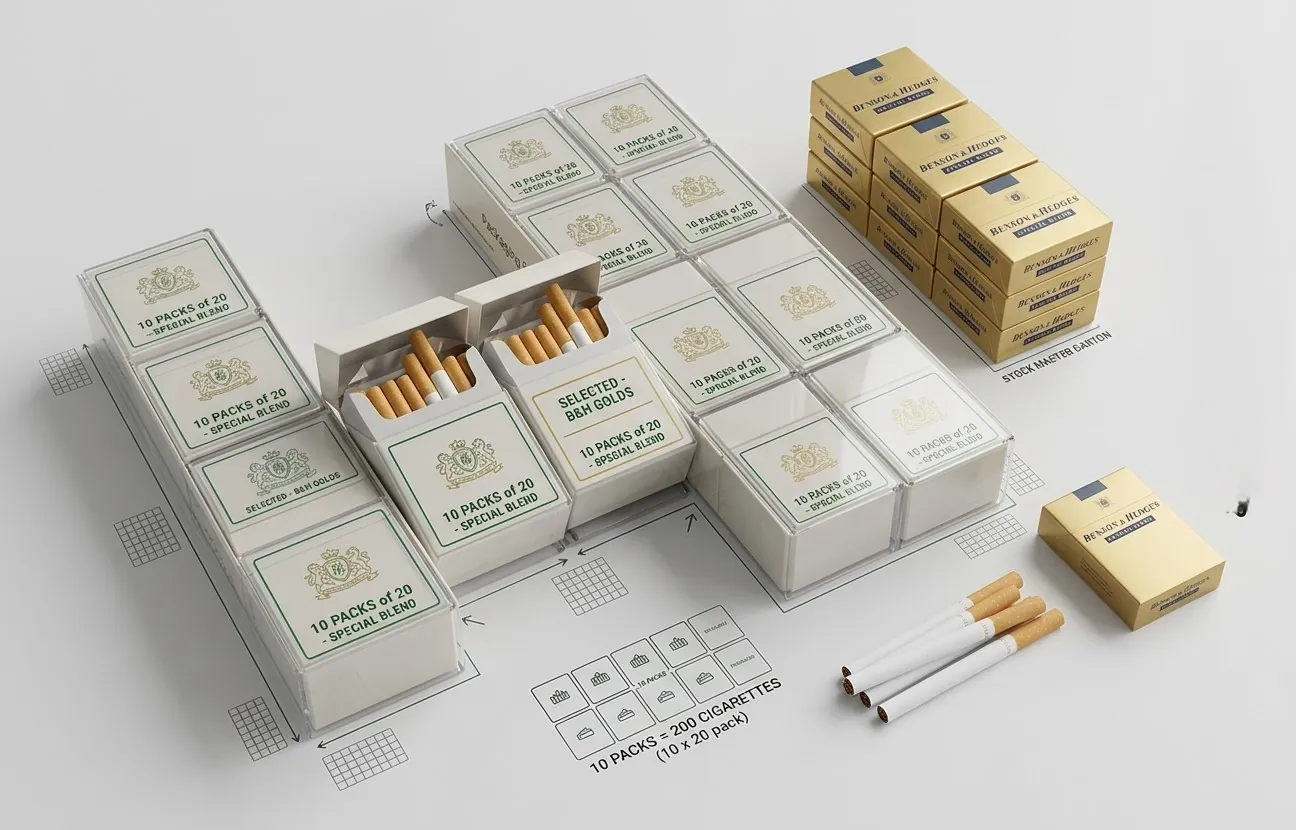
A standard cigarette carton in the United States contains 10 packs. With the usual 20 cigarettes in each pack, that carton holds 200 cigarettes total. This is the standard count readers usually mean when asking how many cigarette packs in a carton.
For a packaging buyer, the answer goes beyond the number ten. Pack dimensions, paperboard thickness, folding style and printed quantity all affect how the carton performs. A carton must hold the intended packs securely and communicate the correct quantity without confusion.
How Many Packs of Cigarettes Are in a Carton in the US?
The usual US retail configuration is ten individual packs inside one outer carton. Each pack remains a separate retail unit, and the carton groups those units for handling, storage, and sale.
The basic relationship is simple:
- One standard pack contains 20 cigarettes.
- One standard carton contains 10 packs.
- Ten packs containing 20 cigarettes each give a total of 200 cigarettes.
- Five standard cartons contain 50 packs, or 1,000 cigarettes.
Ten packs fits inside the outer carton according to the approved packing arrangement. A different pack shape can require a different carton size without changing the number of packs.
Is Every Cigarette Carton Exactly the Same?
Ten packs is the standard US answer, but a packaging term alone does not confirm the contents of every product. Specialty configurations, imported products, and empty packaging orders can use different quantities.
Read the printed count and supplier specification before treating any outer box as a standard carton. A paperboard container made to hold five packs is a five pack container, regardless of how large its graphics make it appear.
How Many Cigarettes in a Pack?
A standard US cigarette pack contains 20 cigarettes. Federal regulations establish a minimum cigarette package size of 20, subject to the exceptions stated in the regulation. That minimum does not mean every legal package must contain exactly twenty. ecfr.gov
The common search question “how many cigs in a pack” has the same practical answer: usually 20 in the United States. The printed quantity remains the reference for a particular product.
Does Cigarette Length Change the Pack Count?
Length and quantity describe different things. Terms such as king size and 100s refer to cigarette formats rather than the number of cigarettes inside a pack.
A taller pack may still contain twenty cigarettes. Its outer carton may need more height, but its total can remain ten packs and 200 cigarettes. It is really the pack measurements that guide the structural work.
How to Calculate a Different Carton Count
Multiply the number of packs by the cigarettes in each pack. For a hypothetical carton holding eight packs of twenty five cigarettes, the total would still be 200. for more information
That example shows why total cigarette count and pack count are separate specifications. For standard US retail questions, ten packs of twenty remains the familiar configuration.
Cigarette Pack, Carton, and Shipping Case
A cigarette pack is the individual package containing cigarettes. A cigarette carton is the outer package holding several finished packs. A shipping case holds multiple cartons for distribution.
These terms matter in purchasing documents. An order for 100 cartons of finished cigarettes is very different from an order for 100 empty paperboard cartons.
What Does an Empty Packaging Order Include?
An empty packaging order normally supplies the printed or unprinted containers described in the quotation. Tobacco products are separate from the packaging itself.
For custom cigarette packaging boxes, state whether the order covers individual packs, outer cartons or both. The quotation should identify the number of empty packaging units, their dimensions, printing details, and delivery condition.
Why Case Quantities Need Separate Confirmation
There is no useful assumption that every shipping case holds the same number of cartons. Case quantities depend on the supplier and distribution arrangement.
Ask for packs per carton and cartons per case as separate figures. This small step prevents a very large quantity mistake during receiving.

Why Paperboard Is Used for Cigarette Cartons
Paperboard provides a printable surface that can be cut, creased, folded, and glued into a compact outer container. Its structure supports grouped packs during ordinary handling and keeps product information together on one package.
The outer panels gives room for quantity statements, identification details and required labeling. Paperboard can offer an affordable packaging format at suitable production volumes, but actual cost depends on specifications rather than appearance alone.
Paperboard Grades and Thickness
Solid bleached sulfate, often called SBS, provides a white printing surface used in many folding carton applications. Other paperboard grades may suit a project depending on stiffness, print requirements, appearance, and material sourcing.
Caliper describes board thickness. GSM describes weight per unit area, so the two measurements should not be treated as interchangeable.
A thicker board is not automatically the best choice. Excess thickness can interfere with folding, closing, or packing equipment. Board selection needs to match the carton structure and production conditions.
Paperboard and Corrugated Board Are Different
A retail paperboard carton usually has a smooth folding structure without a fluted middle layer. Corrugated board contains a fluted medium between liners and is commonly used for shipping cases.
The distinction matters during quotation. Asking for a cardboard box without identifying the material can lead to a proposal for the wrong packaging level.
How Ten Packs Fit Inside a Carton
A familiar arrangement groups ten packs in two rows of five. The exact orientation depends on the pack format, carton structure and filling process.
For a packaging calculation, start with the actual finished pack. Measure its width, depth, and height rather than using cigarette length as a substitute.
Carton Dimensions and Internal Clearance
There is no single carton dimension that fits every cigarette format. Hard packs, soft packs, taller packs, and slimmer formats can require different internal spaces.
The carton needs enough clearance for loading without allowing excessive movement. Too little space can scuff packs or strain seams; too much space can let the contents shift.
Two sample is better than a guess from a screen. A physical prototype loaded with the intended packs reveals problems that a flat drawing can hide.
Dielines, Creases, and Glue Areas
A dieline maps the cut edges, crease lines, panels and glue areas of a folding carton. It gives the printer and converter a shared structural reference.
Artwork should follow the approved dieline. Text placed across a fold or glue seam can become difficult to read after assembly, even when the flat artwork looks acceptable.
Custom Cigarette Packaging Boxes for US Orders
Custom cigarette packaging boxes should begin with a clear structural brief. The supplier needs to know what the carton holds before discussing decorative finishes or large production quantities.
These detail belong in the quotation request:
- Intended US market and packaging level.
- Number of packs per carton.
- Finished dimensions of each pack.
- Internal carton dimensions and loading orientation.
- Paperboard grade and caliper.
- Printing colors, coating, and closure style.
- Required labeling areas and barcode placement.
- Order quantity and delivery format.
Printing, Coatings, and Surface Performance
Offset printing can suit detailed artwork and larger runs. Digital printing may suit some shorter runs or sample work, depending on the supplier’s equipment.
Varnish and other coatings can improve resistance to surface rubbing. Their effect should be tested on the selected paperboard, particularly around folds and glue areas.
A glossy surface does not prove that a carton will survive handling. Board stiffness, folding quality and glue performance carry much of that responsibility.
Prototype Approval Before Production
Approve a structural sample and a print proof before authorizing the full run. One checks fit and assembly; the other checks artwork, color expectations, and text.
For automated packing, test the carton on the intended equipment. A carton do need more than an attractive front panel to work properly on a packing line.
US Labeling, Tax Stamps, and Product Information
US cigarette packaging involves federal requirements and applicable state rules. Quantity information, health warnings, product identification and tax related markings need suitable space.
The FDA regulates cigarette packaging and labeling, including activities involving repacking and relabeling. Packaging changes can carry obligations beyond a routine graphic revision. FDA
Reserve Space for Required Information
Keep required information readable and away from areas that disappear under folds, glue flaps, or closures. Coordinate tax stamp clearance with the intended distribution requirements.
A barcode on an individual pack serves a different packaging level from identification on a carton or shipping case. Confirm the correct code for each level with the product owner.
Check the Current Warning Requirements
Cigarette warning requirements need current verification before printing. FDA reports that court orders have prevented enforcement of its 2020 graphic warning rule, with litigation remaining pending. A printer should not treat every warning diagram shown online as an active requirement for a US production order. FDA
Does European Cigarette Packaging Follow the Same Rules?
European cigarette packaging is useful for comparison, but EU requirements should not be copied directly onto a US carton. European countries outside the EU can have their own rules, too.
Under the EU Tobacco Products Directive, combined health warnings cover 65 percent of the front and back of cigarette packages. EU rules require cigarette packs to have a cuboid shape and prohibit packs containing fewer than twenty cigarettes. European Commission
Keep US Packaging Specifications Separate
A familiar pack count does not make international artwork interchangeable. Warning language, labeling layout, security features and national requirements can differ.
For US orders, use an approved US specification. Treat European cigarette packaging as a separate compliance project rather than a ready printing template.
Carton Pricing, Storage, and Material Recovery
A carton does not automatically cost less than ten individual packs. Retail pricing, taxes and local restrictions affect the comparison.
For a simple example, a carton priced at $90 has an average cost of $9 per pack. This is a calculation example, not a current US market price.
Storage and Protection Limits
Store paperboard cartons in a dry area away from direct sunlight, strong odors, and crushing loads. Paperboard can absorb moisture and lose stiffness under unsuitable storage conditions.
The outer carton groups and supports the packs, but it is not an airtight moisture barrier by itself. Product freshness depends on the complete packaging system, including the individual pack and its barrier materials.
Recycling and Disposal
Recycling options depend on local collection rules and the carton’s material construction. Film, foil layers, coatings and other attached materials can affect acceptance.
Avoid broad claims that every cigarette carton is recyclable everywhere. Use disposal instructions supported by the actual materials and the collection system serving the buyer.
Frequently Asked Questions
How Many Cigarette Packs in a Carton in America?
A standard US carton contains ten packs. With twenty cigarettes per pack, that equals 200 cigarettes.
How Many Cigs in a Pack in the United States?
Twenty is the standard count. Check the printed quantity for the specific product rather than relying on pack size alone.
Does a Carton Contain 100 or 200 Cigarettes?
A standard US carton contains 200 cigarettes. A group of five standard twenty cigarette packs contains 100, which is half the usual carton quantity.
Do 100s Mean There Are 100 Cigarettes in the Pack?
No. The term refers to a cigarette length format. It does not identify the pack count.
Can a Custom Paperboard Carton Hold Fewer Than Ten Packs?
Yes, an empty carton structure can be made for another capacity. The finished tobacco product and its sale must meet applicable requirements, and the quantity description should match the actual contents.
What Should a Packaging Buyer Confirm Before Ordering?
Confirm ten packs per standard US carton, the actual pack dimensions, paperboard specification and approved artwork. Then approve a loaded sample so the printed count, physical fit, and ordering quantity all agree.