Learning how to make a custom box starts with something more basic than artwork or printing. The box has to fit the product, use suitable paperboard, fold correctly and survive the handling expected from it. After those parts are settled, graphics, color and finishing can be added.
For a small project, you can make a custom cardboard box at home with paperboard, a ruler, cutting tool, scoring tool and adhesive. A retail business usually takes another route. It develops dimensions and a dieline, prepares artwork, selects paperboard, creates a prototype and sends the approved design to a packaging manufacturer.
In the United States, custom boxes can range from a single sample to commercial production runs. FedEx Office, for example, currently offers custom box designs with sample quantities starting at one box, plus larger quantities. FedEx Office Commercial folding carton manufacturers may set minimum quantities based on their equipment, material and production method.
Here is how the whole process works.
What Is a Custom Box?
A custom box is packaging made around particular dimensions, structural requirements, graphics or product needs rather than using a standard box exactly as supplied.
Customization can be simple. You might resize a plain paperboard carton to fit a gift. A retail business may need a completely custom folding carton with printed artwork, a window, an insert and a special closure.
Common custom paperboard packaging includes:
- Folding cartons
- Gift boxes
- Product boxes
- Cosmetic cartons
- Food cartons
- Jewelry packaging
- Cereal boxes
- Cake boxes
- Gable boxes
- Popcorn boxes
- Mailer boxes
- Display cartons
The right structure depends on product weight, dimensions, selling environment and how the package will be transported.
How to Make a Custom Box Out of Cardboard
For a basic handmade box, begin with a flat sheet of suitable cardboard or paperboard. Measure the object before drawing anything.
Write its Length, Width and Height.
A product measuring 6 inches long, 4 inches wide and 2 inches high should not automatically receive a box measuring exactly 6 by 4 by 2 inches internally. Products need enough clearance to enter and leave the package, and inserts or protective materials consume some space.
1. Measure Your Product
Measure the longest side for Length, the shorter side for Width and the vertical dimension for Height.
Measure any part that sticks out.
For several products packed together, arrange them in their intended positions first and measure the complete group.
2. Decide the Internal Box Size
Add suitable clearance around the product. The amount varies with the item.
A paperboard carton holding a small cosmetic bottle may require fairly little extra room. A fragile product requiring cushioning needs more.
Do not make the carton much larger than necessary. Excess empty space can let the product move and makes the package look poorly sized.
3. Draw the Box Layout
A folding carton begins as a flat layout often called a dieline.
The dieline shows panels, flaps, cuts and fold lines. A simple rectangular carton can contain front, back and side panels, top and bottom flaps plus a glue tab.
Draw the panels using your finished dimensions. Check every measurement twice before cutting.
4. Cut and Score the Material
Cut around the outside shape of the layout.
Fold lines should be scored rather than fully cut. Scoring creates a controlled line where paperboard can bend.
Use light pressure. Cutting too deeply through the score can weaken or split the carton.
5. Fold and Glue the Box
Fold every scored line before applying adhesive. This helps you see whether the panels line up correctly.
Apply suitable adhesive to the glue tab and join the carton body. Let it set before inserting the product.
This first handmade sample does not need to look beautiful. Its main job is to tell you whether the structure works.
How to Make a Custom Box Size
Custom sizing is one of the main reasons companies move away from stock packaging.
Start with the product rather than a box catalog. Measure the item and determine how it will sit inside the package.
Then account for:
- Product clearance
- Paperboard thickness
- Inserts
- Protective material
- Closures
- Product orientation
- Packing method
Internal and external dimensions are different. Paperboard thickness adds to the outside measurement.
This gets more important with thicker materials and multi layer structures. A small difference can be enough that the product fit feels too loose or too tight.
Make a physical prototype before approving production. A screen measurement can say everything fits and then the actual sample tells a different story, which happen more often than people think.
How to Make a Custom Fit Box
A custom fit carton should hold the product securely without creating unnecessary material.
Place the product inside your prototype. Gently move the carton. If the item slides heavily from side to side, review the dimensions or consider an insert.
If the product is difficult to remove, add clearance.
For bottles, cosmetics, electronics and delicate retail products, inserts can control movement. Paperboard inserts can separate products, create compartments and improve presentation.
Do not make a carton excessively tight just to reduce dimensions. Products have manufacturing tolerances too. One unit may be a little wider than another.
How to Make Custom Boxes at Home
Home production makes sense for prototypes, gifts, school projects, party packaging and very small quantities.
You will typically need:
- Paperboard or cardboard
- Metal ruler
- Measuring tape
- Pencil
- Cutting mat
- Cutting knife
- Scoring tool
- Adhesive
- Printed artwork if required
Make one blank prototype first. Once it folds correctly, use it as the reference for the next version.
For a personalized gift box, decorative paper or printed sheets can be applied depending on the structure. Small gift packaging may be practical to make manually. Producing hundreds by hand gets slow really fast.
Making a Custom Gift Box
Measure the gift and decide whether you want a folding carton, lid and base box or another style.
Allow room for tissue, an insert or decorative material.
For jewelry, the outer box can be quite small, yet an internal holder is often what makes the product sit correctly. A ring box, bracelet carton and watch box do not need the same internal structure.
How to Make Custom Packaging at Home
Packaging involves more than the box itself.
A small business can start with a plain stock carton and personalize it using printed labels, tissue, inserts or custom tape. This approach avoids producing a completely new carton structure during an early product test.
Later, sales volume may justify a custom printed paperboard carton.
This progression is pretty common. Start with what works, test customer response, then invest in production packaging once the dimensions and product format have settled.
FedEx Office currently offers custom packaging elements such as tissue paper, tape, wrapping materials and related branded pieces, showing how a business can combine a box with other printed components rather than treating the carton as the entire packaging system.
How to Make Custom Printed Boxes
Commercial custom printed boxes begin with the structural dieline.
Artwork is placed on a separate design layer that matches that structure. Logos, product names, barcodes, instructions and required information must stay within appropriate areas.
Create the Dieline
The dieline identifies where the carton is cut, folded and glued.
A packaging manufacturer can usually supply a dieline after the dimensions and carton structure are approved.
Do not design important text directly across fold lines or glue areas without a clear reason.
Create the Artwork
Programs such as Adobe Illustrator are commonly suited to packaging artwork. Canva can help create graphics and visual concepts, but a printer may still require a production file prepared to its own technical specifications.
If you search how to make a custom box in Canva, treat Canva mainly as an artwork and concept tool rather than assuming the design on screen automatically becomes a production ready folding carton.
Ask the printer for its file requirements before finalizing anything.
Review a Proof
Review spelling, dimensions, barcode position, panel orientation and color expectations.
Print a paper mockup when possible. Something that appears upright on a flat screen can end up upside down after the carton is folded.
That is an annoying mistake, and a expensive one at volume.
Paperboard Materials for Custom Boxes
Paperboard selection affects printing, feel, stiffness and product protection.
Common folding carton materials include SBS and kraft based board. Commercial suppliers offer different calipers and board types depending on application. Current US supplier listings show SBS and kraft among the materials used for custom folding cartons.
SBS Paperboard
Solid Bleached Sulfate board has a white surface suited to high quality graphics and many retail applications.
It is frequently seen in cosmetics, personal care, food, pharmaceutical and other consumer packaging.
Kraft Paperboard
Kraft based material has a natural brown appearance unless treated or covered differently.
It can suit brands seeking a more natural visual character. Artwork needs to account for the base board color since ink can appear different compared with printing on white stock.
Corrugated Material
Corrugated board is more suitable where shipping strength is the main need.
A folding paperboard product carton and a corrugated shipping box solve different packaging jobs. Some products use both. The retail carton holds the product and a corrugated shipper protects multiple retail cartons during transportation.
How to Make a Custom Box for Shipping
A shipping box needs more attention to transportation stresses than a decorative product carton.
Measure the item and allow enough room for suitable cushioning. Protect corners and areas likely to receive impact.
For an unusual object, start with a corrugated sheet or an existing larger carton. Mark the required dimensions, resize the panels and create new folds.
Seal the finished shipping carton properly before sending it.
US consumers who do not want to build an unusual shipping carton themselves have professional options. The UPS Store states that its locations can create custom boxes and crates for irregular items.
How to Make a Custom Size Box for Shipping
Do not reduce the shipping box until it touches the product on every side. Shipping protection needs space.
Measure:
Product dimensions plus required cushioning equals approximate internal box dimensions
Build a sample and pack the product exactly as it would be shipped. Then measure the outside Length, Width and Height.
These external measurements are the ones that matter for many shipping calculations.
A smaller properly designed shipping carton can reduce unused space and material. Yet reducing size beyond what protection requires can result in damage, so there is a balance here.
How to Make Custom Mailer Boxes
Mailer boxes are popular for ecommerce, subscription kits and promotional packages.
A mailer typically uses folding panels and locking tabs to form a box without the same closure arrangement as a basic shipping carton.
Designing one from scratch is more difficult than making a simple rectangular box since tabs and panels have to interact properly.
For commercial use, ask the manufacturer to develop the structural dieline. Then build the graphics around that approved template.
FedEx Office currently lists custom mailers among its printed box options and offers standard or custom dimensions.
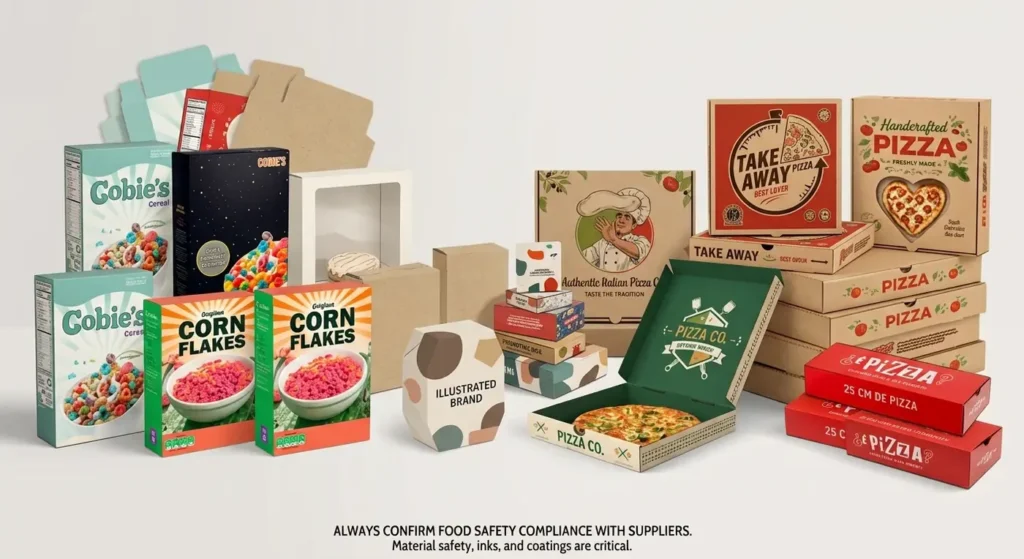
How to Make a Custom Cereal, Cake or Pizza Box
Different products need different structures.
A cereal style carton is typically a folding paperboard structure. Artwork has large front and back panels, plus narrow side panels.
Cake boxes need dimensions that provide room for the cake and make loading practical. The board and any direct food contact requirements must match the intended application.
Pizza boxes normally use corrugated board or another structure suited to food delivery rather than ordinary thin retail paperboard.
Never assume that a material is suitable for direct food contact merely since it is paper based. Ask the supplier about the exact material, ink, coating and intended food application.
Custom Jewelry, Toy and Game Boxes
Jewelry packaging often relies heavily on inserts. The outer dimensions may be simple, but presentation depends on how the item sits inside.
Toy and game packaging can require larger printed panels, trays, windows or internal compartments.
Collectible style packaging can involve printed cartons and clear components. If you are creating packaging inspired by an existing commercial product such as LEGO, Pokémon, Funko or Hot Wheels, avoid copying protected brand artwork, logos or trade dress for commercial use without permission.
Making an original box for your own product is the safer route.
How Much Does It Cost to Make a Custom Box?
There is no universal price for a custom carton.
Cost changes with:
- Dimensions
- Paperboard type
- Material thickness
- Quantity
- Printing method
- Number of printed surfaces
- Structural design
- Inserts
- Finishing
- Shipping
- Setup requirements
Quantity can make a major difference. One prototype may have a high unit cost, yet thousands of cartons can have a much lower unit price.
Current US market offerings show how widely minimum quantities vary. FedEx Office advertises sample custom box quantities as low as one, whereas commercial folding carton suppliers may start at dozens, hundreds or much larger production quantities.
Get quotes using the same dimensions, board, printing and quantity so the comparisons actually mean something.
How to Get a Custom Box Made
For business packaging, prepare a short specification before contacting suppliers.
Include:
- Internal Length, Width and Height
- Product weight
- Box style
- Paperboard preference
- Required quantity
- Printing requirements
- Insert requirements
- Delivery location
- Desired production date
Ask for a dieline and prototype or sample before a large order.
The sample should be tested with the real product inside. Check fit, closure, opening experience, printed panel orientation and how cartons pack into shipping cases.
Do not approve it just from a computer rendering. The physical carton is where small structural problem become obvious.
From a Simple Box to Production Packaging
The basic answer to how to make a custom box is straightforward. Measure the product, determine the internal dimensions, select a structure, draw a dieline, cut and score the material, assemble a prototype and test the fit.
Commercial paperboard packaging adds more stages. Material selection, printing, artwork, inserts, proofs and production quantities enter the process. This is why making one handmade gift carton is quite different from producing 10,000 retail boxes.
Start with structure before decoration. A beautiful carton that does not close or hold its product is still a bad box. Get the fit right, test a physical sample and then move into printing and larger production. That approach keeps the process practical, and it can save a business from a very costly packaging mistake.
Frequently Asked Questions
Can I make my own custom box?
Yes. A simple paperboard box can be measured, drawn, cut, scored, folded and glued at home. Commercial packaging requires more controlled production.
Can UPS make a custom box?
The UPS Store states that it can provide custom boxes and crates for unusually shaped shipping items. Services can differ by location.
Can FedEx make a custom box?
FedEx Office offers custom packing solutions for unusually shaped or oversized items and custom printed box options for businesses.
Can I order a custom box with no minimum?
Some US providers offer sample quantities of one custom printed box. Production manufacturers may have higher minimum order quantities.
How do I make a custom cardboard box for shipping?
Measure the product, allow room for cushioning, create the box around those internal dimensions, fold the structure and secure it. Test the packed box before shipping valuable goods.
What is the best material for a custom product box?
It depends on product weight and use. SBS and kraft paperboard are common options for folding cartons. Corrugated material is commonly better for shipping applications.
Do I need a dieline for a custom printed box?
Yes, commercial folding cartons normally use a structural dieline so artwork can be positioned around panels, folds, cuts and glue areas.